
How Automatic Identification Systems Work and What to Check Before Vessel Installation
Automatic identification systems sit at the center of modern vessel visibility, but installation decisions should never be reduced to a box-checking exercise.
For retrofit and newbuild projects, AIS reliability depends on how the unit interacts with antennas, sensors, power, surrounding electronics, and compliance rules.
That makes the topic especially relevant in a mobility landscape where GNCS tracks precision perception, safety architecture, and the real operating value of high-reliability equipment.
What automatic identification systems actually do at sea
In simple terms, automatic identification systems broadcast and receive vessel data over VHF radio channels.
The transmitted message usually includes identity, position, course, speed, navigational status, and other voyage-related information.
Nearby ships, coastal stations, traffic services, and integrated bridge displays use that information to improve situational awareness.
This is why automatic identification systems are often discussed alongside radar, GNSS, ECDIS, and voyage monitoring tools rather than as isolated devices.
Their value grows when the surrounding navigation architecture is stable, correctly connected, and electrically clean.
The basic operating logic
AIS obtains position and timing from a GNSS source, either internal or external.
It packages static data, dynamic movement data, and voyage data into standardized message formats.
Those messages are transmitted on dedicated VHF frequencies using a time-sharing method that reduces collision between signals.
At the same time, the unit listens for broadcasts from other vessels and shore infrastructure.
That two-way exchange is what turns automatic identification systems into a live maritime traffic layer.
Why AIS remains a technical priority
AIS is no longer viewed only as a compliance instrument.
It affects collision avoidance support, fleet monitoring, port coordination, incident reconstruction, and digital navigation workflows.
In dense traffic, poor weather, or restricted waters, data latency or signal loss can have operational consequences far beyond display inconvenience.
This is where GNCS’s focus on precise spatial perception becomes relevant.
A navigation system is only as trustworthy as the signal chain behind it.
The same discipline used to assess safety-critical automotive components also applies here: interface integrity, environmental robustness, and compliance traceability matter before deployment.
Class differences and installation implications
Not all automatic identification systems serve the same operational profile.
Class A units typically support SOLAS-related requirements and higher reporting performance.
Class B units are more common on smaller commercial craft and certain non-SOLAS vessels.
That distinction affects transceiver behavior, integration depth, display expectations, and approval pathways.
The installation checks that shape real-world performance
The most common AIS problems are not caused by the transceiver itself.
They usually appear at the interfaces around it.
Antenna position is a first-order issue
VHF antenna placement influences range, transmission clarity, and resistance to shadowing from masts or deck structures.
Separation from other antennas also matters.
If AIS shares crowded RF space with radar, satellite communication, or other VHF services, interference risks increase.
Power quality cannot be treated casually
Automatic identification systems require stable power input and well-managed grounding.
Voltage dips, transients, or noisy supply lines may trigger restarts, message errors, or intermittent outages.
On vessels with aging electrical systems, this checkpoint deserves extra attention before sign-off.
Sensor integration must be verified, not assumed
Heading, rate of turn, speed, and position can come from several onboard sources.
The question is whether message sentences, baud rates, priorities, and failover logic are correctly aligned.
A technically complete installation can still produce poor traffic data if sensor inputs are mismatched or stale.
EMC review is essential
Electromagnetic compatibility is often underestimated during tight retrofit windows.
Yet automatic identification systems operate in an environment full of transmitters, switching devices, power converters, and digital networks.
Cable routing, shielding, bonding, and equipment spacing should be reviewed before commissioning, not after unexplained faults appear.
Compliance is broader than carrying an approved unit
A type-approved product does not automatically guarantee a compliant vessel installation.
Documentation, software version status, bridge integration records, and test evidence all contribute to acceptance.
Depending on vessel type and trading route, flag administration, classification society, and port state expectations may not be identical.
That is why automatic identification systems should be reviewed as part of a complete navigation compliance package.
GNCS regularly follows these rule intersections across marine and broader mobility sectors, where certification details often decide operational readiness.
Typical scenarios where evaluation quality makes a difference
Some projects expose AIS weaknesses faster than others.
- Retrofits on older bridge layouts, where antenna real estate and cable routes are constrained.
- Newbuild integration, where AIS must work cleanly with ECDIS, radar overlays, and centralized alarm handling.
- High-traffic regional operations, where target density increases the cost of weak transmission performance.
- Harsh electrical environments, especially on vessels with frequent generator switching or complex auxiliary loads.
- Compliance-sensitive fleets, where audit documentation and long-term maintainability matter as much as day-one functionality.
In each case, automatic identification systems should be assessed as part of the vessel’s full perception and communication stack.
A practical review path before vessel installation
A useful pre-installation review starts with context rather than hardware.
Define vessel class, route profile, traffic density, bridge architecture, and mandatory reporting expectations.
Then move through the technical stack in a disciplined order.
- Confirm the required AIS class and approval basis.
- Map every sensor source and data interface.
- Review antenna location, feeder losses, and RF separation.
- Check supply stability, grounding, and backup arrangements.
- Plan EMC controls before final cable installation.
- Prepare commissioning tests that prove transmission and display performance.
- Retain configuration records for future inspection and troubleshooting.
This approach reduces the chance that automatic identification systems will pass bench checks but underperform in service.
Where to look next
A strong AIS decision is rarely about selecting a transceiver alone.
It comes from comparing installation constraints, data architecture, regulatory pathways, and lifecycle support expectations.
When those elements are reviewed together, automatic identification systems become more than reporting tools.
They become dependable contributors to navigational awareness, traceable compliance, and long-term vessel safety performance.
The next step is to build an evaluation checklist tied to the actual vessel, then test every interface that could affect live maritime visibility before installation approval.
Related News

How to Specify Integrated Marine Electronics for Reliable Bridge Operations
Integrated marine electronics: learn how to specify reliable bridge systems with clear data flows, redundancy, alarm control, lifecycle interfaces, and operational testing.

How to Evaluate Navigation Radar Manufacturers for Commercial Vessel Projects
Navigation radar manufacturers: learn how to compare performance, compliance, integration, support, and lifecycle cost for commercial vessel projects.

How Adjustable Cabin Ergonomics Reduce Operator Fatigue in Long-Shift Vehicles
Adjustable cabin ergonomics reduces operator fatigue through better seating, reach, visibility, vibration control, and climate comfort for safer long-shift vehicles.

How Rear-Impact Safety Components Work Together to Protect Vehicle Occupants
Explore how automotive safety components for rear impact work together—from crash structures and seats to head restraints and belts—to enhance occupant protection.
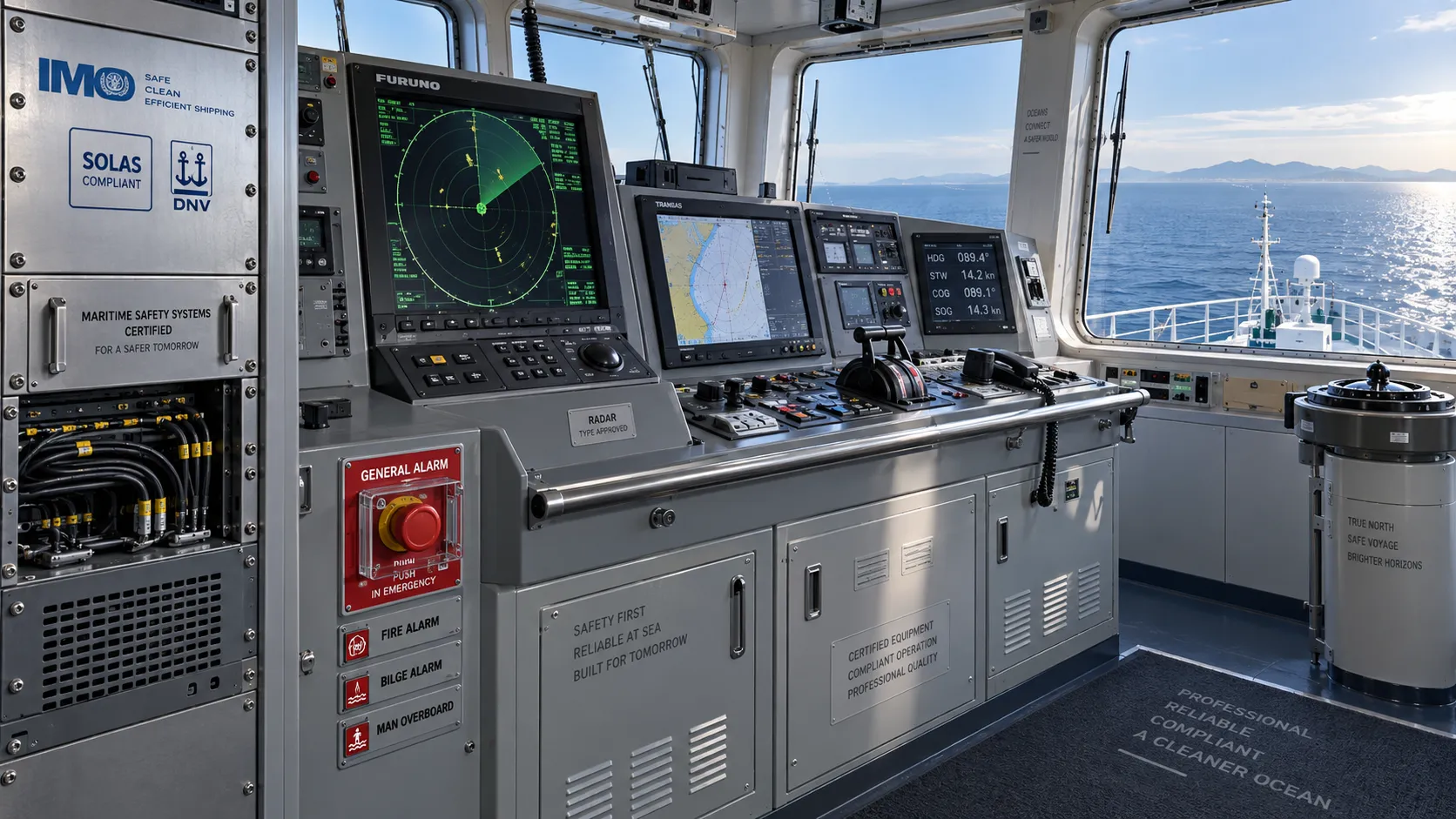
How to Evaluate a Marine Safety Systems Manufacturer for Vessel Compliance and Reliability
Marine safety systems manufacturer evaluation guide: verify compliance, engineering quality, lifecycle costs, and global service support for safer, reliable vessel operations.

Crash Test Regulations for Seatbelts: Key Compliance Requirements Explained
Crash test regulations seatbelts explained: explore FMVSS, UN rules, anchorage strength, and dynamic restraint testing for safer, compliant vehicle systems.

How to Calculate the Total Cost of Automotive Lightweighting for a Vehicle Program
Automotive lightweight solutions cost: learn how to calculate program-level costs, including materials, tooling, joining, validation, risk, and vehicle-level value.

How Automotive Seat Occupancy Sensing Improves Airbag Deployment Decisions
Automotive seat occupancy sensing helps optimize airbag deployment decisions, improving passenger classification, safety diagnostics, and compliance across real-world conditions.

What Drives Lightweight Body Component Costs in High-Volume Vehicle Programs?
Lightweight body components cost depends on material yield, forming, joining, tooling, validation, and logistics. Explore proven ways to optimize total vehicle program cost.
Related News
- 00
0000-00
How to Evaluate Navigation Radar Manufacturers for Commercial Vessel Projects - 00
0000-00
How to Evaluate Cargo Marine Sonar Systems for Detection Range and Vessel Fit - 00
0000-00
How to Evaluate Marine Signal Processing Software for Radar and Sonar Integration - 00
0000-00
How Do Automatic Identification Systems Improve Vessel Tracking and Collision Avoidance? - 00
0000-00
How to Choose Marine Navigation Systems for Patrol Boats in Coastal and Offshore Missions
Weekly Insights
Stay ahead with our curated technology reports delivered every Monday.