
How to Choose Marine Navigation Systems for Commercial Vessels: Key Functions and Buying Criteria
Choosing marine navigation systems for commercial vessels is not just a technical task. It directly affects voyage safety, compliance, bridge workload, fuel efficiency, and maintenance planning.
A good buying decision starts with function, but it should end with operational fit. The best system is not always the most advanced one. It is the one that works reliably in real sea conditions.
For commercial fleets, that usually means checking positioning accuracy, radar and AIS integration, ECDIS compatibility, alarm logic, cyber update support, and lifecycle service capacity.
GNCS closely follows high-precision navigation technology and compliance intelligence across global mobility equipment. That broader view matters, because reliable sensing, safety logic, and system integration are now linked across industries.
Start with the functions that matter at sea
When comparing marine navigation systems, begin with the functions that affect actual bridge decisions. Fancy interfaces look good in demos, but core performance under weather, traffic, and signal stress matters more.
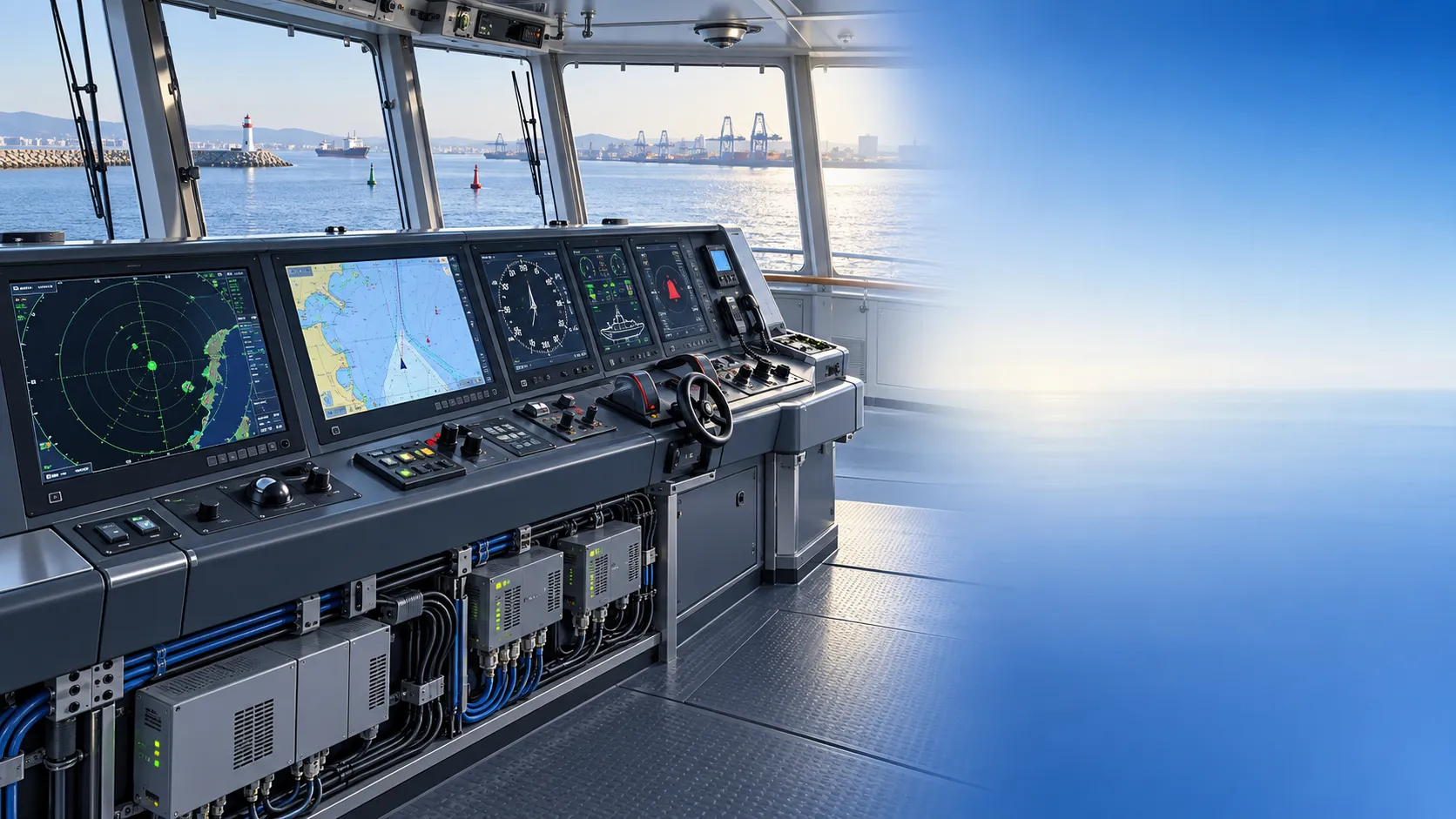
[Image 01: Commercial vessel bridge with integrated marine navigation systems display]
- Prioritize multi-source positioning, including GPS, GNSS backup, and sensor fusion, so the vessel maintains usable navigation data during interference, satellite drift, or temporary signal loss.
- Check radar overlay quality on chart displays, because weak alignment between radar and ECDIS often creates confusion during pilotage, congestion, poor visibility, or night operations.
- Confirm AIS data handling speed and filtering logic, so target tracking stays readable instead of overloading the bridge with cluttered contacts and low-value alarms.
- Review alarm hierarchy and acknowledgment flow, because too many non-critical alerts reduce operator attention when a real navigational threat appears without warning.
- Ask for fail-safe architecture details, including redundant processors, power protection, and fallback modes, to reduce the operational impact of single-point system failures.
- Evaluate display readability in glare, vibration, and rough weather, since a technically capable system still underperforms if bridge teams cannot read it quickly.
Do not treat ECDIS compatibility as a box-ticking item
Many buying teams check whether a system “supports ECDIS” and move on. That is too shallow. The real question is how smoothly charts, radar, route planning, sensor inputs, and updates work together.
Ask how chart updates are delivered, validated, and logged. Cloud-based update protocols are improving, but control, traceability, and rollback procedures still matter for compliance and operational confidence.
Compare buying criteria beyond the specification sheet
A specification sheet helps narrow options, but it rarely reveals long-term ownership risks. For marine navigation systems, support quality and integration discipline are often more important than isolated hardware numbers.
- Measure supplier experience by vessel type and route profile, because coastal cargo operations, offshore support vessels, and ocean-going ships face very different navigation demands.
- Request documented integration cases with radar, autopilot, gyrocompass, sonar, and voyage data systems, reducing hidden engineering effort during retrofit or newbuild delivery.
- Compare software update policy, cybersecurity practices, and patch frequency, since connected marine navigation systems need both stability and controlled improvement over time.
- Review spare parts availability and service response windows in key ports, because downtime costs can quickly outweigh any savings from a lower initial purchase price.
- Check training support for bridge teams and technicians, especially for alarm management, route planning, and failure recovery, where poor familiarity can create avoidable safety risks.
- Use total cost of ownership, not equipment price alone, including licensing, updates, calibration, installation labor, and future expansion requirements.
Match the system to the operating scenario
Not every vessel needs the same navigation stack. The right marine navigation systems setup depends heavily on voyage pattern, crew workload, and the complexity of traffic or weather exposure.
Coastal and short-sea routes
These operations usually face dense traffic, frequent course changes, and repeated port entries. Fast target refresh, clean radar overlay, and practical alarm management often matter more than extreme feature depth.
Check whether operators can switch views quickly during high-tempo maneuvers. If interface steps are too deep, even a strong system can slow decisions at the worst moment.
Deep-sea and ocean-going vessels
Long-range operations place more weight on redundancy, chart update control, failure recovery, and support across multiple regions. Service coverage becomes a technical requirement, not just a commercial bonus.
This is where GNCS-style intelligence tracking becomes useful. Monitoring compliance changes, update protocols, and reliability trends helps reduce the risk of buying systems that age poorly.
Retrofit projects
Retrofits often fail because buyers underestimate interface complexity. Legacy wiring, space constraints, bridge layout, and mixed-brand equipment can delay installation and increase validation work.
Before selecting marine navigation systems, request a clear integration map. It should show protocols, display dependencies, cabinet impact, and any crew retraining that the retrofit will trigger.
Watch for the details people often miss
A lot of buying mistakes come from focusing on features and ignoring usability, resilience, and support discipline. These details may look minor during tender review, but they drive real-world results.
- Do not overlook sensor calibration and alignment needs, because inaccurate inputs can quietly degrade marine navigation systems even when hardware appears fully operational.
- Check licensing structure for charts, modules, and updates, since hidden recurring fees often distort the true long-term budget after installation is complete.
- Ask how the system behaves during partial failures, not only complete failures, because degraded-mode usability often determines whether bridge teams stay effective.
- Review human-machine interface consistency across screens, helping reduce training time and preventing avoidable operator error during stressful navigation conditions.
- Confirm compliance documentation is current and easy to audit, especially for international operations where inspection readiness must be maintained across multiple jurisdictions.
- Verify vendor roadmap stability, because unsupported platforms can create expensive replacement cycles long before the equipment reaches expected service life.
Reliability is wider than electronics
In complex mobility equipment, reliability comes from system design, not just component quality. GNCS tracks this idea across navigation, passive safety, and smart cabin systems because the same logic keeps repeating.
Good protection depends on how sensing, logic, hardware, and updates work together. That is as true for airbag assemblies and seatbelt systems as it is for marine navigation systems.
A practical way to make the final decision
If several options look similar, use a weighted review model. Keep it simple. Score operational fit, integration risk, lifecycle cost, compliance confidence, and service responsiveness.
- Build a short evaluation matrix with weighted criteria, so decisions reflect operational priorities instead of being driven mainly by the most persuasive sales presentation.
- Request live demonstrations using realistic voyage scenarios, including traffic density, signal interruptions, and alarm events, to expose practical strengths and weaknesses early.
- Include engineering, bridge operation, and maintenance feedback in the review, because marine navigation systems affect more than one function onboard and ashore.
- Use reference checks from comparable vessels and routes, which often reveal service issues, update friction, or usability concerns not visible in tender documents.
- Plan acceptance testing before contract close, defining interface checks, redundancy verification, and training completion to avoid unclear responsibility after delivery.
The strongest purchase decisions usually come from disciplined comparison, not speed. When marine navigation systems are evaluated through real operating conditions, hidden risks become much easier to see.
A smart next step is to shortlist only the systems that meet core navigation, integration, and support requirements, then validate them against the vessel’s actual route profile and retrofit reality.
That approach keeps the decision practical, reduces lifecycle surprises, and helps ensure the selected marine navigation systems deliver safe, stable performance long after installation.
Related News
How to Specify Integrated Marine Electronics for Reliable Bridge Operations
Integrated marine electronics: learn how to specify reliable bridge systems with clear data flows, redundancy, alarm control, lifecycle interfaces, and operational testing.

How to Evaluate Navigation Radar Manufacturers for Commercial Vessel Projects
Navigation radar manufacturers: learn how to compare performance, compliance, integration, support, and lifecycle cost for commercial vessel projects.

How Adjustable Cabin Ergonomics Reduce Operator Fatigue in Long-Shift Vehicles
Adjustable cabin ergonomics reduces operator fatigue through better seating, reach, visibility, vibration control, and climate comfort for safer long-shift vehicles.

How Rear-Impact Safety Components Work Together to Protect Vehicle Occupants
Explore how automotive safety components for rear impact work together—from crash structures and seats to head restraints and belts—to enhance occupant protection.
How to Evaluate a Marine Safety Systems Manufacturer for Vessel Compliance and Reliability
Marine safety systems manufacturer evaluation guide: verify compliance, engineering quality, lifecycle costs, and global service support for safer, reliable vessel operations.

Crash Test Regulations for Seatbelts: Key Compliance Requirements Explained
Crash test regulations seatbelts explained: explore FMVSS, UN rules, anchorage strength, and dynamic restraint testing for safer, compliant vehicle systems.

How to Calculate the Total Cost of Automotive Lightweighting for a Vehicle Program
Automotive lightweight solutions cost: learn how to calculate program-level costs, including materials, tooling, joining, validation, risk, and vehicle-level value.

How Automotive Seat Occupancy Sensing Improves Airbag Deployment Decisions
Automotive seat occupancy sensing helps optimize airbag deployment decisions, improving passenger classification, safety diagnostics, and compliance across real-world conditions.

What Drives Lightweight Body Component Costs in High-Volume Vehicle Programs?
Lightweight body components cost depends on material yield, forming, joining, tooling, validation, and logistics. Explore proven ways to optimize total vehicle program cost.
Related News
- 00
0000-00
How to Specify Integrated Marine Electronics for Reliable Bridge Operations - 00
0000-00
How Adjustable Cabin Ergonomics Reduce Operator Fatigue in Long-Shift Vehicles - 00
0000-00
How to Evaluate a Marine Safety Systems Manufacturer for Vessel Compliance and Reliability - 00
0000-00
How to Calculate the Total Cost of Automotive Lightweighting for a Vehicle Program - 00
0000-00
What Drives Lightweight Body Component Costs in High-Volume Vehicle Programs?
Weekly Insights
Stay ahead with our curated technology reports delivered every Monday.