
Maritime Compliance Checklist: What Buyers Should Confirm Before Procurement
A solid maritime compliance review starts well before a purchase order is issued. Price, lead time, and brand reputation matter, but they do not prove legal fit, safe operation, or long-term maintainability.
In practice, the better question is simple: what must be confirmed now to avoid detention, retrofit cost, or unsafe performance later? That is where a usable maritime compliance checklist becomes essential.
This matters even more for navigation electronics, bridge systems, and connected safety equipment. Certification status, software update duties, test evidence, and serial traceability often decide whether procurement risk stays controlled.
GNCS follows these issues closely through its Strategic Intelligence Center, where marine navigation regulation, digital update practices, and reliability signals are observed as part of broader mobility safety intelligence.
What does maritime compliance really cover before procurement?
Many teams treat maritime compliance as a document check. That is too narrow. Real compliance covers the product, the supplier, the records, and the post-delivery obligations tied to operation.
For marine navigation systems, this usually includes type approval, relevant IMO and SOLAS alignment, flag and class acceptance, cybersecurity posture, and service support across trading routes.
A useful maritime compliance checklist should also ask whether the delivered configuration matches the approved configuration. A compliant platform can become non-compliant after an undocumented hardware or firmware change.
That is why compliance is not only about design intent. It is also about configuration control, installation boundaries, update discipline, and evidence that can survive inspection.
The quickest way to frame the scope
- Product legality: approvals, standards, and declared operating limits.
- Supplier credibility: factory controls, change management, and service history.
- Evidence quality: test reports, certificates, manuals, and traceable identifiers.
- Lifecycle readiness: updates, spare parts, maintenance intervals, and obsolescence planning.
Which documents should be checked first, and which ones are often misunderstood?
The first review should focus on validity, scope, and consistency. A certificate alone says little if the model number, software build, manufacturer name, or test basis does not match the offered item.
One common mistake is accepting expired or region-limited approvals. Another is relying on a brochure statement such as “compliant to standard” without third-party evidence or issuing authority details.
For connected bridge equipment, software declarations deserve special attention. ECDIS, radar integration, AIS, and positioning interfaces can remain technically functional while falling outside approved update conditions.
The table below helps separate documents that merely support a bid from documents that truly support maritime compliance.
How do you tell whether a supplier supports compliance after delivery?
This is where many buying decisions become fragile. Maritime compliance is rarely static, especially when navigation systems depend on firmware, data interfaces, cybersecurity patches, or route-specific service support.
A capable supplier should explain who controls updates, how change notices are issued, what revalidation is required, and how long the product will remain supported.
If the answer is vague, lifecycle risk is already visible. Equipment may be legal at delivery but difficult to defend during survey, audit, incident review, or spare part replacement.
GNCS often tracks this same pattern across high-reliability sectors. Whether the system is a marine radar or a safety-critical cabin component, post-release control is where technical credibility becomes measurable.
Useful questions to raise before contract signature
- Who approves firmware changes, and how are vessels notified?
- Does any update affect type approval, class acceptance, or interface certification?
- What service network covers the intended operating regions?
- How long are critical boards, sensors, and modules guaranteed available?
- What evidence is provided after repair, replacement, or field modification?
Where do buyers usually misjudge risk in a maritime compliance checklist?
The most frequent mistake is equating low visible cost with low total risk. In marine procurement, missing evidence can create hidden cost through delays, repeat testing, integration failure, and survey findings.
Another weak point is interface assumption. A compliant subsystem may still create operational risk if connection protocols, power conditions, or display logic differ from vessel requirements.
There is also a documentation trap. Some suppliers provide polished manuals but weak revision control. When a claim, failure, or inspection arises, the record trail becomes too thin to defend.
In actual projects, stronger maritime compliance decisions usually come from comparing risk in four directions, not one.
- Regulatory risk: can the installation pass class, flag, and port scrutiny?
- Operational risk: will the system perform reliably in harsh marine conditions?
- Data risk: are software, interface, and update records fully controlled?
- Commercial risk: are warranty, support, and replacement terms realistic?
Is there a practical way to compare offers without losing compliance detail?
Yes, but the comparison should not start with unit price. A better method is to build a short evaluation sheet around proof quality, configuration clarity, and lifecycle obligation.
That keeps the maritime compliance review tied to procurement reality. It also reduces the chance of choosing an offer that looks complete on paper but creates uncertainty during installation or operation.
A simple scoring logic often works better than a long narrative. The point is not mathematical perfection. The point is consistent judgment.
What should be done just before final approval and contract release?
At the final stage, the maritime compliance checklist should move from document collection to commitment control. Every critical promise needs a named deliverable, timing point, and responsibility line.
That includes certificate copies, revision-controlled manuals, as-built configuration records, update responsibilities, training scope, spare part commitments, and non-conformance handling rules.
It also helps to confirm how future evidence will be stored. If records are scattered across email threads, proving compliance later becomes unnecessarily hard.
In sectors watched by GNCS, the strongest procurement decisions usually come from disciplined evidence stitching. That means linking technical parameters, approval status, and operational support into one defensible file.
Final pre-award checks worth keeping on one page
- Approved model, revision, and software baseline are frozen in writing.
- Required maritime compliance documents are listed as contract attachments.
- Field changes, repairs, and updates have a documented approval route.
- Support coverage, lead times, and parts availability are contract-visible.
- Acceptance criteria include evidence review, not only physical delivery.
A reliable maritime compliance process is less about paperwork volume and more about decision clarity. The goal is to know exactly what has been approved, what may change, and who carries responsibility when conditions shift.
Before moving forward, refine the checklist around the actual equipment scope, compare proof quality across offers, and confirm lifecycle obligations with the same rigor used for price and delivery.
If the review still feels fragmented, start by organizing certificates, traceability records, update rules, and service commitments into one comparison sheet. That single step often reveals the real procurement risk faster than any brochure can.
Related News

How to Specify Integrated Marine Electronics for Reliable Bridge Operations
Integrated marine electronics: learn how to specify reliable bridge systems with clear data flows, redundancy, alarm control, lifecycle interfaces, and operational testing.

How to Evaluate Navigation Radar Manufacturers for Commercial Vessel Projects
Navigation radar manufacturers: learn how to compare performance, compliance, integration, support, and lifecycle cost for commercial vessel projects.

How Adjustable Cabin Ergonomics Reduce Operator Fatigue in Long-Shift Vehicles
Adjustable cabin ergonomics reduces operator fatigue through better seating, reach, visibility, vibration control, and climate comfort for safer long-shift vehicles.

How Rear-Impact Safety Components Work Together to Protect Vehicle Occupants
Explore how automotive safety components for rear impact work together—from crash structures and seats to head restraints and belts—to enhance occupant protection.
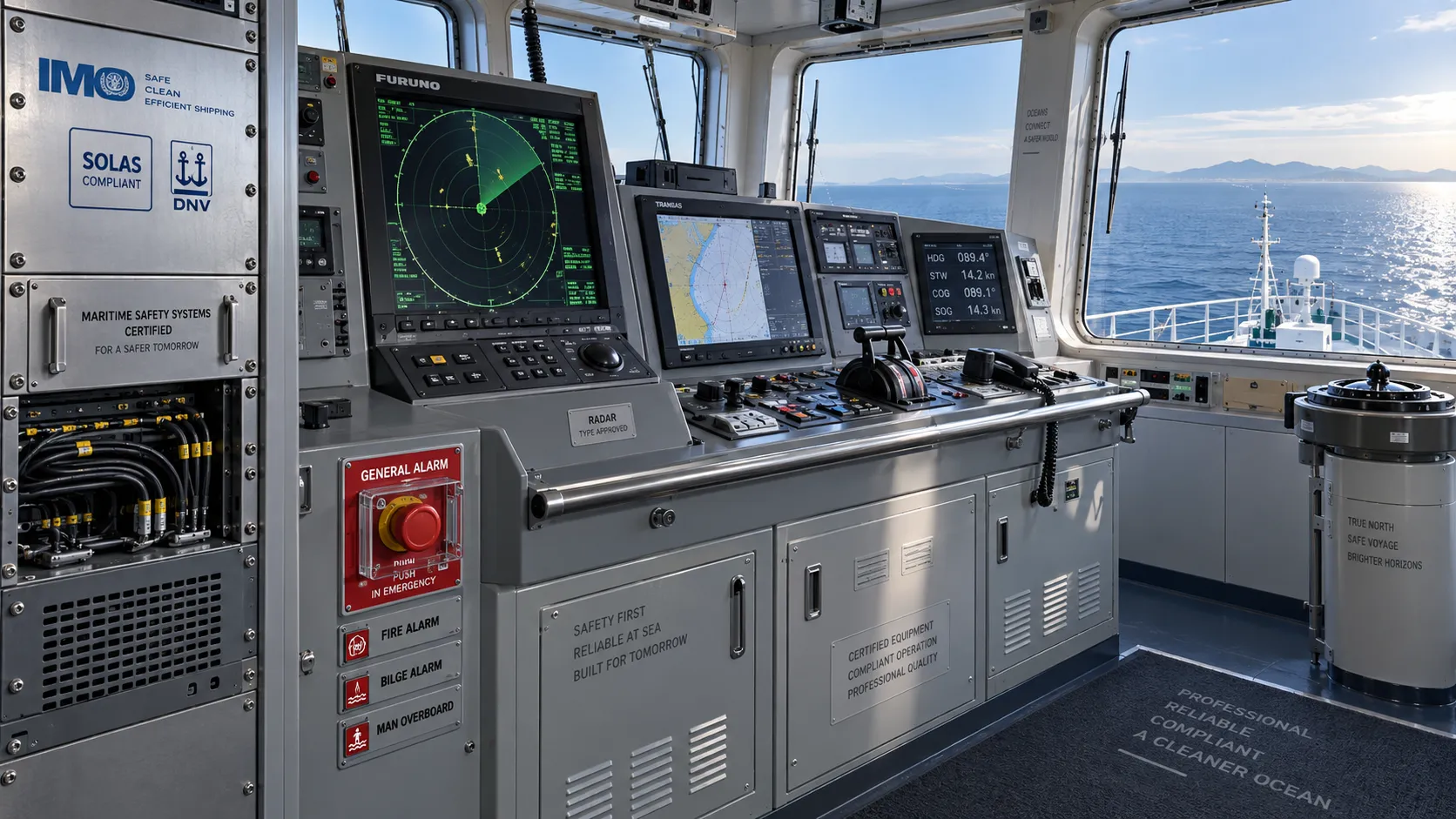
How to Evaluate a Marine Safety Systems Manufacturer for Vessel Compliance and Reliability
Marine safety systems manufacturer evaluation guide: verify compliance, engineering quality, lifecycle costs, and global service support for safer, reliable vessel operations.

Crash Test Regulations for Seatbelts: Key Compliance Requirements Explained
Crash test regulations seatbelts explained: explore FMVSS, UN rules, anchorage strength, and dynamic restraint testing for safer, compliant vehicle systems.

How to Calculate the Total Cost of Automotive Lightweighting for a Vehicle Program
Automotive lightweight solutions cost: learn how to calculate program-level costs, including materials, tooling, joining, validation, risk, and vehicle-level value.

How Automotive Seat Occupancy Sensing Improves Airbag Deployment Decisions
Automotive seat occupancy sensing helps optimize airbag deployment decisions, improving passenger classification, safety diagnostics, and compliance across real-world conditions.

What Drives Lightweight Body Component Costs in High-Volume Vehicle Programs?
Lightweight body components cost depends on material yield, forming, joining, tooling, validation, and logistics. Explore proven ways to optimize total vehicle program cost.
Related News
- 00
0000-00
How to Specify Integrated Marine Electronics for Reliable Bridge Operations - 00
0000-00
How Adjustable Cabin Ergonomics Reduce Operator Fatigue in Long-Shift Vehicles - 00
0000-00
How to Evaluate a Marine Safety Systems Manufacturer for Vessel Compliance and Reliability - 00
0000-00
How to Calculate the Total Cost of Automotive Lightweighting for a Vehicle Program - 00
0000-00
What Drives Lightweight Body Component Costs in High-Volume Vehicle Programs?
Weekly Insights
Stay ahead with our curated technology reports delivered every Monday.