
Automotive Compliance Information for EVs: Which Standards Matter for New Programs?
Automotive Compliance Information for EVs: Which Standards Matter First?
For a new EV program, automotive compliance information EV teams track should shape design choices from day one.
It affects battery architecture, body structure, cabin restraint systems, software strategy, sourcing plans, and launch timing.
That is why compliance work is no longer a late certification step.
It is an early program control tool.
In practice, the hardest part is not finding standards.
It is deciding which standards will actually drive engineering effort, budget exposure, and validation sequence.
GNCS follows this space closely because EV compliance rarely sits in one domain.
Battery protection, lightweight body behavior, seat systems, airbags, and global crash expectations all interact.
A good compliance map connects those disciplines before change requests begin to pile up.
What does automotive compliance information EV programs really need to include?
A useful compliance package is broader than a homologation list.
It should show mandatory regulations, voluntary ratings, supplier evidence, and test dependencies across regions.
For EVs, four clusters usually matter most.
- Battery and electrical safety, including thermal propagation, isolation, and post-crash behavior.
- EMC and electrical disturbance, especially with high-voltage systems, charging, and connected modules.
- Passive safety, including body-in-white load paths, airbags, seatbelts, and seat integrity.
- Software and cybersecurity, particularly for updates, diagnostics, and connected vehicle functions.
The phrase automotive compliance information EV teams use should therefore include both legal and engineering evidence.
A regulation may say what must pass.
A supplier standard often reveals what will consume time.
That distinction matters when body stampings, inflator chemistry, or smart seat electronics are still evolving.
More mature teams also track consumer protocols such as Euro NCAP or IIHS.
Those are not always legal gates, but they strongly influence target setting and design margin.
Which standards usually drive the biggest decisions in a new EV launch?
Not every standard has the same program impact.
Some shape documentation, while others reshape hardware.
The table below highlights where automotive compliance information EV programs should focus first.
Battery safety often dominates early because failures are costly to redesign.
A thermal event requirement can alter enclosure material, cooling layout, and underbody impact protection.
Passive safety comes next because EV mass distribution changes crash pulse behavior.
That directly affects hot-stamped structures, seat mounting, restraint timing, and occupant kinematics.
The automotive compliance information EV leaders value most is therefore the information tied to redesign risk.
When do global rules start to conflict with each other?
Conflicts rarely appear as obvious contradictions.
They show up as different test methods, approval logic, or evidence formats.
An EV designed for Europe, China, and North America may meet the same safety intent through different pathways.
Battery abuse tests are a common example.
Regional expectations may differ on propagation thresholds, warning time, or documentation depth.
The same is true for charging interfaces, software update control, and data security records.
More subtle conflicts happen between legal compliance and market expectations.
A vehicle can pass regulation but still underperform in a consumer rating program.
That can hurt launch credibility, especially in segments where cabin protection and technology confidence matter.
A practical way to manage this is to build a single requirement tree.
Map each target to region, component owner, test article, timing, and evidence source.
Without that structure, automotive compliance information EV teams collect becomes fragmented and harder to trust.
Where do new EV programs most often underestimate compliance risk?
The first mistake is treating standards as static.
Regulations move, but assessment protocols and customer expectations move even faster.
The second mistake is separating component compliance from vehicle behavior.
A compliant seat, airbag, or battery module can still fail in system integration.
This is especially relevant for GNCS-tracked areas such as seat structures, restraint systems, and lightweight crash parts.
Weight reduction is valuable, but it changes pulse management and attachment durability.
Another frequent blind spot is software governance.
If update strategy is defined late, approval and traceability work can delay market entry.
The same applies to EMC.
Teams often discover disturbance issues after packaging is frozen, when shielding changes become expensive.
A shorter warning list helps keep automotive compliance information EV planning practical:
- Do not assume supplier pass reports cover vehicle-level approval.
- Do not separate crash targets from battery enclosure decisions.
- Do not delay cybersecurity and update process ownership.
- Do not treat rating protocols as optional if brand positioning depends on them.
How should a team prioritize standards without slowing the whole program?
The useful question is not how many standards exist.
It is which ones can trigger architecture changes, tooling changes, or revalidation loops.
Start by ranking standards against three filters: redesign cost, evidence lead time, and regional impact.
That quickly separates paperwork-heavy items from true program drivers.
In real programs, the highest-priority items usually involve batteries, crash structures, restraints, EMC, and connected systems.
A second layer should cover materials, flammability, seating performance, labeling, and production conformity.
This is also where sector intelligence becomes useful.
GNCS often connects compliance signals across body engineering, passive safety, and cabin systems rather than viewing them in isolation.
That kind of cross-domain reading helps identify where one change creates pressure elsewhere.
For example, a lighter seat frame may support range targets.
It can also change anchorage loads, restraint geometry, and occupant protection outcomes.
The next step is simple.
Build one live compliance matrix tied to design freeze milestones, supplier deliverables, and regional launch plans.
That turns automotive compliance information EV efforts into a decision tool instead of a reporting archive.
What is the most practical takeaway before a new EV program locks its targets?
The key point is that standards matter most when they still have power to change the product.
If compliance review begins after architecture freeze, cost and delay risks rise sharply.
Strong automotive compliance information EV planning should answer a few direct questions.
- Which standards will alter hardware design if missed early?
- Which regional pathways require different evidence or test sequencing?
- Which suppliers own critical proof, and how will that proof be verified?
- Which safety or rating targets are commercially necessary, even if not legally mandatory?
Once those answers are visible, prioritization becomes much easier.
The program can then align sourcing, validation, and launch timing around the standards that truly matter.
A sensible next move is to review the requirement tree by subsystem, compare regional gaps, and flag every item with redesign potential.
That is usually where schedule protection begins.
Related News

Which Passive Safety Engineering Standards Apply to Automotive Restraint Systems?
Passive safety engineering standards for automotive restraint systems: explore FMVSS, UN regulations, seatbelts, airbags, anchors, and compliance planning.

How European B2B Teams Can Evaluate Product Intelligence Platforms for Sourcing
B2B product intelligence platform Europe: learn how procurement teams assess suppliers, compliance data, technical capabilities, and sourcing risks with confidence.

How to Evaluate Magnesium Alloys Corrosion Resistance for Marine Parts?
Magnesium alloys corrosion resistance for marine parts depends on more than alloy grade. Learn how to assess coatings, galvanic risk, geometry, and real-world exposure before you decide.

How to Evaluate Mobility Safety Systems for Safer Vehicle Platform Design
Mobility safety systems evaluation starts with platform architecture, crash energy management, and seat-restraint timing. Learn how to choose safer, validation-ready vehicle designs.

How Seat Belt Pretensioners for EVs Improve Crash Safety and System Response
Seat belt pretensioners for EVs improve crash timing, occupant control, and system response. Discover how smarter integration boosts EV safety performance.
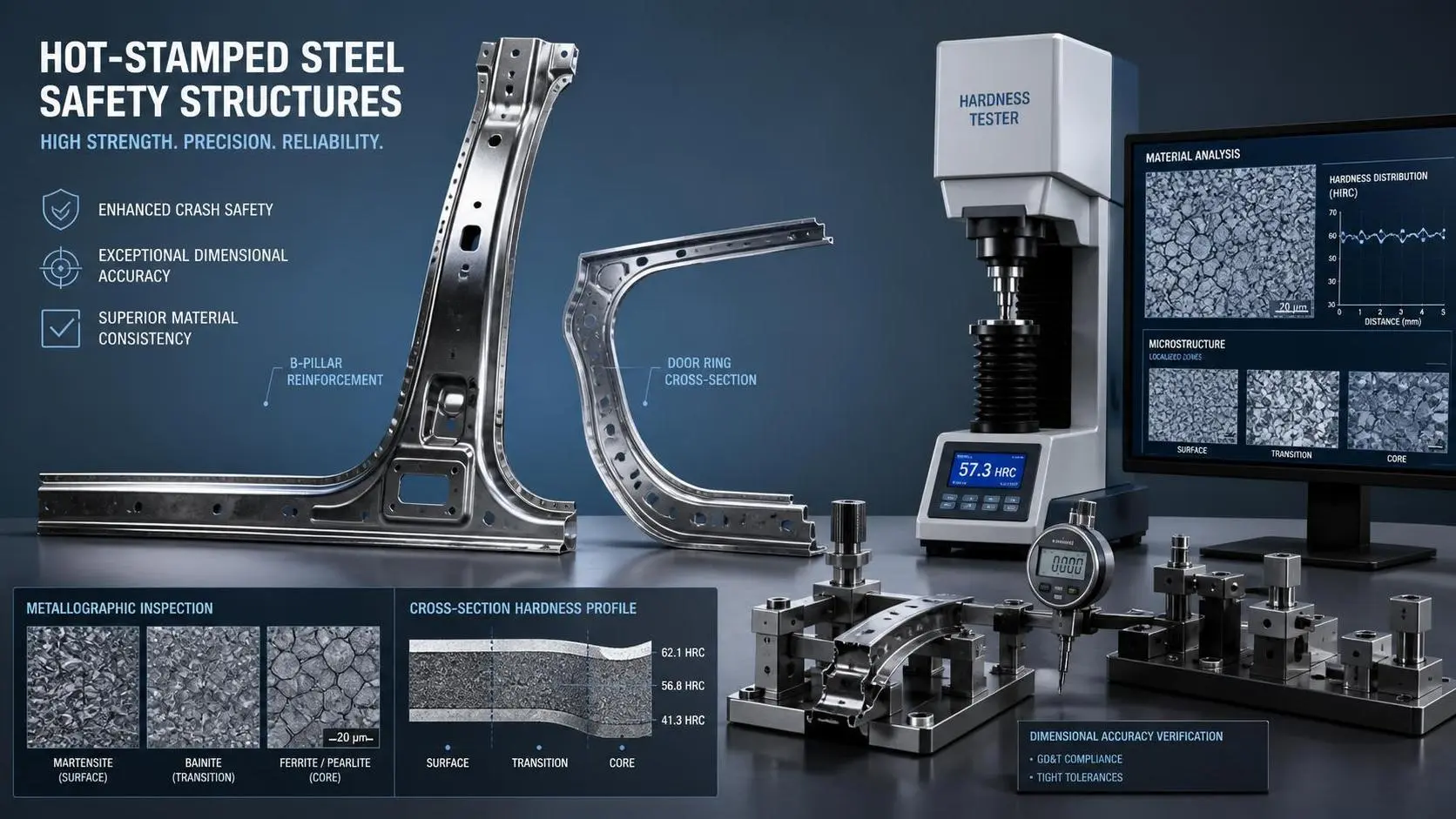
How to Evaluate High Strength Hot Stamped Steel Parts for Crash-Safety Applications
High strength hot stamped steel parts for crash-safety applications: learn how to assess strength, microstructure, dimensional accuracy, and process stability for safer sourcing decisions.

How Crash Management Components Reduce Repair Costs and Improve Impact Performance
Crash management components help reduce repair costs, protect critical vehicle structures, and improve impact performance. Learn how smarter design supports safer, more cost-efficient mobility programs.

How to Evaluate a Seat Sensing Systems Factory for Automotive Safety Programs
Seat sensing systems factory selection goes beyond price. Learn how to assess quality control, validation, PPAP readiness, and long-term supply reliability for safer automotive programs.

Supplier Capability Evaluation Process: Key Criteria for B2B Sourcing Decisions
Supplier capability evaluation process explained: learn the key criteria for B2B sourcing decisions, reduce supplier risk, and choose partners with confidence.
Related News
- 00
0000-00
Automotive Compliance Information for EVs: Which Standards Matter for New Programs? - 00
0000-00
Crash test standards are changing what cars must prove - 00
0000-00
What crash test regulations now mean for new designs - 00
0000-00
Crash test regulations are changing faster than many plans - 00
0000-00
Maritime Safety Technology Updates That May Affect Fleet Compliance
Weekly Insights
Stay ahead with our curated technology reports delivered every Monday.