
Maritime Compliance Standards Checklist: What to Review Before Vessel System Approval
Maritime compliance standards are no longer a late-stage box to tick
Vessel system approval has become more demanding, more digital, and less forgiving of weak evidence.
That shift is visible across navigation electronics, bridge integration, safety controls, software updates, and cybersecurity expectations.
In practice, maritime compliance standards now influence design choices much earlier than many teams expect.
A missing test record or unclear interface description can delay approval as much as a hardware fault.
This matters because vessel systems are no longer judged only as isolated devices.
They are reviewed as connected, updateable, safety-relevant parts of a wider mobility ecosystem.
For GNCS, this pattern is familiar.
Whether the focus is marine navigation, cabin restraint systems, or lightweight structural safety, approval pressure is moving toward traceability, resilience, and measurable performance.
So before a vessel system enters formal review, the smartest move is to treat maritime compliance standards as a pre-approval discipline.
Why review expectations have tightened in recent cycles
Several signals explain why maritime compliance standards are receiving closer scrutiny.
- Navigation systems now depend on layered data from GNSS, radar, sonar, AIS, and software-based fusion.
- Remote maintenance and cloud-connected updates create benefits, but also raise control and verification questions.
- Cross-border operations expose systems to different flag, class, and port-state review expectations.
- Cybersecurity has moved from a niche concern to a practical approval issue.
- Investigations after incidents increasingly examine documentation integrity, not only technical failure.
More importantly, marine approval logic is beginning to resemble wider safety industries.
Automotive passive safety, for example, already treats validation evidence, version control, and performance consistency as core compliance assets.
The marine side is moving in the same direction.
That does not mean every standard is identical.
It means approval culture now rewards systems that can prove reliability under real operating complexity.
The checklist starts earlier than certification paperwork
A common mistake is to reduce maritime compliance standards to certificates collected near launch.
In reality, reviewers often form confidence long before the final document package appears.
The strongest pre-approval checklist usually covers six linked areas.
1. Regulatory mapping and scope definition
Confirm which maritime compliance standards actually apply to the system, vessel type, route profile, and installation role.
This includes IMO frameworks, SOLAS-related obligations, class rules, IEC references, and flag-state specifics where relevant.
Scope drift creates avoidable rework.
2. Documentation quality and technical traceability
Review system architecture, interface definitions, bill of materials, firmware versions, safety notes, and installation instructions.
Documents should be internally consistent.
A mismatch between wiring diagrams and software release notes is a warning sign.
3. Test evidence and environmental robustness
Check EMC performance, vibration tolerance, temperature range, ingress protection, power stability, and fault recovery behavior.
Maritime compliance standards increasingly expect evidence that reflects harsh operating conditions, not ideal lab assumptions.
4. Navigation integrity and operational safety
For bridge or navigation systems, verify signal accuracy, sensor synchronization, alarm logic, fail-safe modes, and human-machine clarity.
An approved system must not only function.
It must remain interpretable during stress, interference, or degraded inputs.
5. Cybersecurity and software governance
Review access control, patch policy, update authentication, change logs, rollback strategy, and network segmentation assumptions.
This has become one of the fastest-rising elements within maritime compliance standards.
6. Certification readiness and evidence packaging
Ensure reports, declarations, drawings, manuals, and approval references are complete, current, and easy to audit.
Good evidence structure shortens review cycles.
Where approval delays usually begin
Most delays do not begin with dramatic technical collapse.
They begin with weak alignment between system claims and reviewable proof.
This is why maritime compliance standards should be reviewed as an evidence chain.
If one link is vague, the whole approval story becomes harder to defend.
The impact does not stop at marine navigation hardware
A broader industrial pattern is emerging.
High-reliability sectors are borrowing discipline from each other.
GNCS tracks this across marine electronics and cabin safety systems.
In both domains, compliance now depends on how physical performance and digital behavior interact.
For vessels, that means electromagnetic signal processing, alarm management, redundancy logic, and software maintenance all affect approval confidence.
For automotive safety systems, it means crash energy absorption, sensor timing, and restraint actuation must show the same discipline.
The common lesson is clear.
Compliance is no longer just about passing a known standard once.
It is about proving repeatable control across design, manufacturing, updates, and field conditions.
What deserves closer attention before formal vessel system approval
From recent demand signals, several checkpoints are becoming more decisive.
- Whether software-enabled functions are tied to a controlled release and verification plan.
- Whether navigation data remains stable under signal loss, interference, or degraded sensor confidence.
- Whether onboard users can understand alarms without confusion during workload peaks.
- Whether test methods reflect actual installation environments, not generic bench conditions.
- Whether third-party modules introduce hidden compliance gaps through undocumented dependencies.
- Whether approval files are structured for external review, not only internal engineering use.
These points may seem procedural.
Yet they often determine whether maritime compliance standards are experienced as manageable or disruptive.
A practical way to judge readiness without waiting for rejection
One useful approach is to run a pre-approval review as if an external examiner were already involved.
That review should ask four direct questions.
Can the system claim be traced to a defined standard requirement?
Can the requirement be traced to test evidence or validated analysis?
Can the approved configuration be distinguished from older or modified versions?
Can a reviewer understand operating limits without informal explanation?
If any answer is weak, the issue is usually deeper than paperwork.
It points to a control gap that maritime compliance standards will eventually expose.
The next smart move is disciplined observation, not last-minute correction
The direction of travel is clear.
Maritime compliance standards are becoming more integrated with software assurance, operational resilience, and lifecycle accountability.
That will likely intensify as vessels become more connected and approval bodies demand cleaner evidence chains.
A useful next step is to compare current system files against the checklist areas above.
Then review which items rely on assumption rather than proof.
It also helps to monitor updates in class guidance, software governance expectations, and navigation system validation methods.
For anyone tracking high-reliability equipment through the GNCS lens, the broader insight is consistent.
Approval readiness improves when technical precision and compliance intelligence are built together, not stitched together at the end.
That is the most reliable way to reduce approval friction, protect safety credibility, and keep vessel programs moving with fewer surprises.
Related News

How to Specify Integrated Marine Electronics for Reliable Bridge Operations
Integrated marine electronics: learn how to specify reliable bridge systems with clear data flows, redundancy, alarm control, lifecycle interfaces, and operational testing.

How to Evaluate Navigation Radar Manufacturers for Commercial Vessel Projects
Navigation radar manufacturers: learn how to compare performance, compliance, integration, support, and lifecycle cost for commercial vessel projects.

How Adjustable Cabin Ergonomics Reduce Operator Fatigue in Long-Shift Vehicles
Adjustable cabin ergonomics reduces operator fatigue through better seating, reach, visibility, vibration control, and climate comfort for safer long-shift vehicles.

How Rear-Impact Safety Components Work Together to Protect Vehicle Occupants
Explore how automotive safety components for rear impact work together—from crash structures and seats to head restraints and belts—to enhance occupant protection.
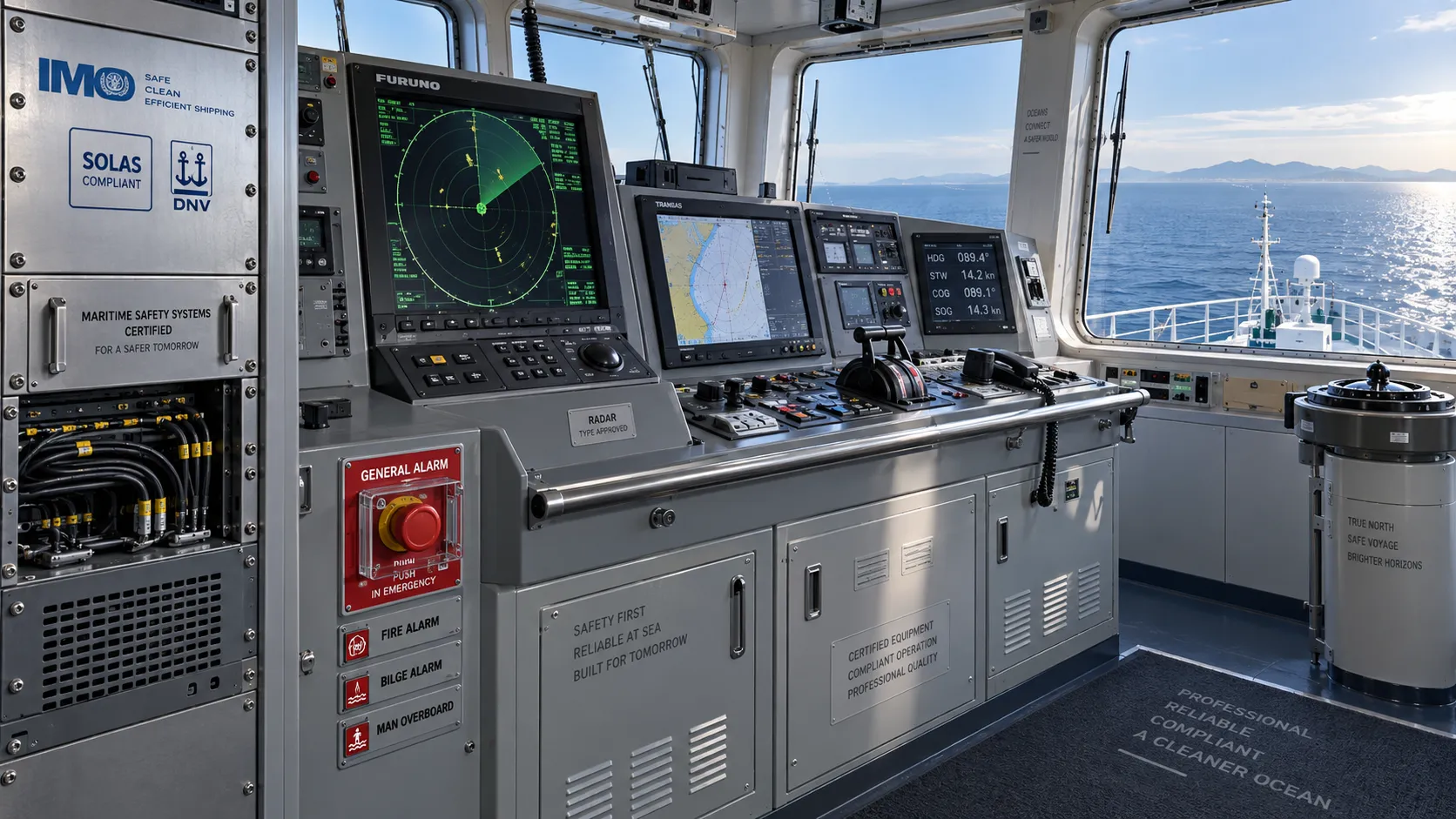
How to Evaluate a Marine Safety Systems Manufacturer for Vessel Compliance and Reliability
Marine safety systems manufacturer evaluation guide: verify compliance, engineering quality, lifecycle costs, and global service support for safer, reliable vessel operations.

Crash Test Regulations for Seatbelts: Key Compliance Requirements Explained
Crash test regulations seatbelts explained: explore FMVSS, UN rules, anchorage strength, and dynamic restraint testing for safer, compliant vehicle systems.

How to Calculate the Total Cost of Automotive Lightweighting for a Vehicle Program
Automotive lightweight solutions cost: learn how to calculate program-level costs, including materials, tooling, joining, validation, risk, and vehicle-level value.

How Automotive Seat Occupancy Sensing Improves Airbag Deployment Decisions
Automotive seat occupancy sensing helps optimize airbag deployment decisions, improving passenger classification, safety diagnostics, and compliance across real-world conditions.

What Drives Lightweight Body Component Costs in High-Volume Vehicle Programs?
Lightweight body components cost depends on material yield, forming, joining, tooling, validation, and logistics. Explore proven ways to optimize total vehicle program cost.
Related News
- 00
0000-00
How to Specify Integrated Marine Electronics for Reliable Bridge Operations - 00
0000-00
How Adjustable Cabin Ergonomics Reduce Operator Fatigue in Long-Shift Vehicles - 00
0000-00
How to Evaluate a Marine Safety Systems Manufacturer for Vessel Compliance and Reliability - 00
0000-00
How to Calculate the Total Cost of Automotive Lightweighting for a Vehicle Program - 00
0000-00
What Drives Lightweight Body Component Costs in High-Volume Vehicle Programs?
Weekly Insights
Stay ahead with our curated technology reports delivered every Monday.