
Global maritime compliance gaps that delay vessel deployment
Global maritime compliance gaps can quietly derail vessel deployment, driving costly redesigns, approval delays, and cross-border coordination risks for project leaders. For engineering and program managers balancing technical readiness with market deadlines, understanding where regulatory mismatches emerge is essential. This article explores how global maritime compliance issues affect deployment schedules and what teams can do to reduce disruption, protect certification timelines, and improve execution confidence.
Why compliance gaps delay deployment more than most teams expect
The core search intent behind global maritime compliance is practical, not academic. Project leaders want to know why a vessel that appears technically ready still cannot enter service on schedule.
For most programs, the problem is not one major regulatory failure. It is the accumulation of smaller mismatches across equipment approvals, flag requirements, classification rules, documentation packages, and crew readiness.
These gaps often remain hidden until integration, inspection, sea trials, or final review. By that stage, even minor findings can trigger schedule compression, redesign loops, and difficult supplier coordination.
For engineering managers, the overall judgment is clear: global maritime compliance should be managed like a deployment-critical workstream, not treated as an end-stage documentation exercise.
What project managers and engineering leads care about most
Target readers in vessel programs usually care about five questions. What exactly causes delays, which gaps are most likely, how early they can be detected, who owns resolution, and how to avoid cost escalation.
They also need to understand the business effect. A compliance miss does not only slow approval. It can delay charter revenue, disrupt shipyard slots, increase change-order costs, and weaken customer confidence.
That is why the most useful approach is not to restate regulations broadly. It is to identify the specific failure points that commonly interrupt deployment across international maritime operations.
The most common global maritime compliance gaps that create delays
Several compliance gaps repeatedly affect deployment schedules. The first is misalignment between flag state requirements and assumptions made during design or procurement.
A system accepted in one operating context may still require additional documentation, testing, labeling, or software control evidence for another jurisdiction. Teams often discover this after equipment delivery, not before purchase.
The second gap is class and statutory overlap. Project teams may assume that class approval automatically covers all statutory acceptance requirements. In practice, these pathways can differ in timing, evidence, and responsible parties.
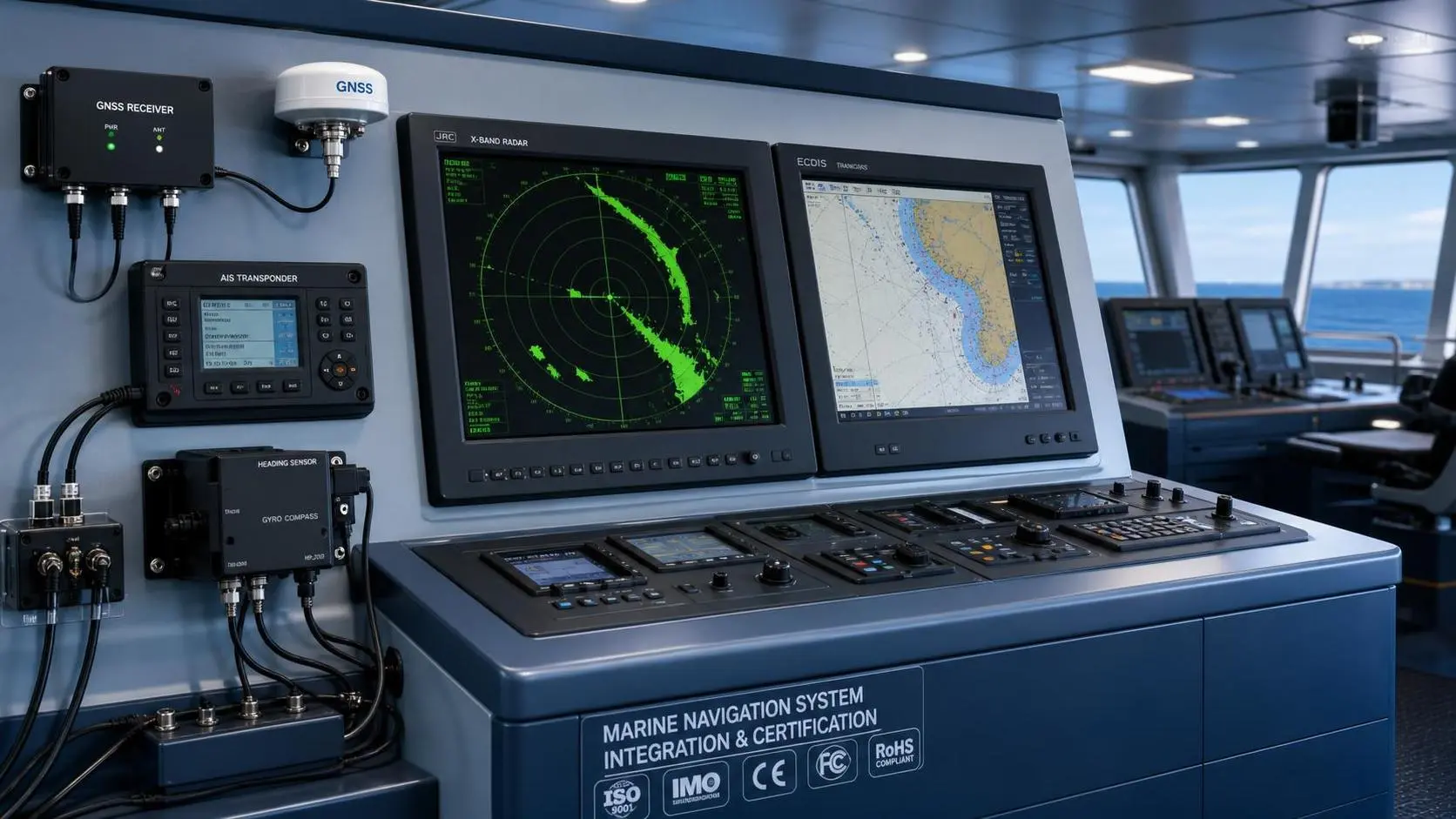
Third, integrated bridge, navigation, and communication systems create complex dependencies. Marine navigation systems may be individually compliant, but their combined installation, software version control, cybersecurity posture, and interface validation may not be.
Fourth, document control failures are a major source of delay. Drawings, certificates, manuals, test records, and change histories may exist, but not in the exact form required by inspectors, owners, or authorities.
Fifth, late engineering changes often invalidate prior approvals. A cable routing update, console modification, enclosure material substitution, or software patch can trigger re-review even if the technical change seems small.
Sixth, supplier qualification assumptions create hidden exposure. Global maritime compliance depends not only on the vessel integrator but also on whether sub-tier vendors can provide traceable evidence on time.
Even a well-made component can become a deployment blocker if type approval status has lapsed, documentation is incomplete, or test standards differ from the project baseline.
Why compliance gaps often emerge late in the program
Many teams ask why these issues surface so late. The answer usually lies in fragmented ownership. Design, procurement, commissioning, quality, suppliers, and external reviewers often manage different compliance fragments without one integrated map.
Commercial schedules can make this worse. When procurement teams prioritize lead time and price, they may select technically suitable equipment before confirming market-specific acceptance conditions.
Another reason is the false confidence created by previous projects. Teams may assume that because a system worked on one vessel, it will transfer smoothly to another flag, route, owner specification, or digital architecture.
In reality, compliance is highly contextual. Operating area, vessel type, retrofit versus newbuild status, software revision, and interface architecture can all affect approval pathways.
This is especially important for advanced navigation and safety equipment, where digital integration and update management now play a larger role than simple hardware conformity.
High-risk areas in marine navigation and onboard safety systems
Within GNCS-relevant sectors, marine navigation systems are among the most sensitive compliance areas because they combine precision electronics, software governance, installation constraints, and human-machine interface requirements.
ECDIS configuration, radar integration, AIS interoperability, gyro input integrity, alarm management, and bridge layout can all become approval concerns if the final system differs from reviewed assumptions.
Cybersecurity is another rising issue. Even where core rules are understood, implementation evidence may be weak. Access control, patch procedures, update governance, and network segmentation are now increasingly relevant to deployment readiness.
Passive safety and cabin-related domains matter less directly to vessel deployment than navigation systems, but the pattern is similar. Cross-border compliance problems often arise where performance claims, materials, traceability, and validation evidence are not aligned early.
For teams monitoring broader mobility sectors, intelligence sources such as 无 can be useful when comparing how high-reliability industries manage approval evidence and integration risk.
How to detect deployment risk before inspections begin
Program leaders need an early-warning method, not just a final checklist. The most effective step is to build a compliance matrix at the start of the project and keep it live.
This matrix should map each critical system to flag requirements, class rules, owner specifications, type approval status, interface dependencies, test obligations, and document owners.
It should also identify trigger points for re-evaluation. Any software change, equipment substitution, layout revision, or supplier shift should automatically prompt a compliance impact review.
Second, teams should run milestone-based compliance reviews at design freeze, procurement release, FAT, installation completion, harbor trials, and sea trials. Waiting until final certification review is too late.
Third, project managers should maintain a red-list of high-risk items. These usually include navigation software versions, bridge integration records, statutory certificates nearing expiry, and components sourced from multiple regional suppliers.
Fourth, involve approvers early. Classification societies, notified bodies where applicable, and owner representatives can clarify interpretation differences before engineering assumptions harden into costlier reality.
What an effective compliance control model looks like
A useful control model has four layers: governance, technical interpretation, supplier evidence, and deployment readiness tracking. Weakness in any one layer can delay the entire vessel.
Governance means one accountable owner for cross-functional compliance status. This person does not replace specialists, but consolidates risk visibility and escalation paths.
Technical interpretation means rules are translated into design and commissioning actions early. Teams should avoid leaving requirements in abstract regulatory language with no engineering owner.
Supplier evidence means all critical vendors must deliver type approvals, test reports, revision histories, declarations, and manuals according to agreed timing and formatting rules.
Deployment readiness tracking means compliance status is measured like schedule or cost. If a package is 90 percent built but only 40 percent certifiable, it is not deployment ready.
How to reduce delay risk in multinational vessel programs
Multinational programs face added complexity because design may happen in one country, equipment sourcing in another, integration in a third, and final operation under a separate flag.
In these cases, project leaders should standardize evidence templates across all suppliers. Different certificate styles, test formats, and naming conventions create avoidable review friction later.
It also helps to define a single source of truth for revision control. Many compliance failures are really version-control failures disguised as technical issues.
Another practical measure is to separate “approved in principle” from “approved for this vessel.” Teams often confuse generic acceptance with installation-specific acceptance, and deployment suffers as a result.
Where system complexity is high, a specialist intelligence function can add value by monitoring regulatory updates, software-related rule changes, and cross-market interpretation trends. That need is one reason sector platforms like 无 are increasingly relevant to engineering decision-makers.
Questions project leaders should ask before locking the schedule
Before committing to a deployment date, project managers should ask several direct questions. Which approvals are assumption-based rather than confirmed? Which suppliers have documentation delivery risk? Which changes could reopen prior reviews?
They should also ask whether bridge and safety systems have been assessed as integrated operational environments, not just as standalone compliant products.
If the team cannot answer these questions confidently, the schedule likely contains hidden compliance risk. It is better to expose that uncertainty early than absorb it during final commissioning.
Conclusion: compliance discipline is deployment discipline
Global maritime compliance delays are rarely caused by regulation alone. They usually come from weak coordination between technical design, supplier evidence, installation reality, and approval sequencing.
For project management and engineering leaders, the most important takeaway is simple: treat compliance as a core execution discipline from project launch onward.
When teams build clear ownership, maintain a live compliance matrix, validate integration assumptions early, and manage supplier evidence rigorously, vessel deployment becomes far more predictable.
In a market where schedule certainty and technical credibility both matter, closing global maritime compliance gaps is not just about passing inspection. It is about protecting launch timing, commercial value, and execution confidence.
Related News

How to Specify Micro-Climate Control Cabins for Harsh Outdoor Worksites?
Micro-climate control cabins for harsh outdoor worksites: learn how to specify thermal control, filtration, pressurization, and durability for safer uptime and smarter buying.

How to Evaluate a B2B Product Knowledge Platform for Faster Procurement Decisions
B2B product knowledge platform procurement starts with reducing decision risk. Learn how to compare specs, compliance, and supplier data to speed sourcing with confidence.

How to Evaluate an Occupant Restraint Systems Exporter for Quality, Compliance, and Supply Risk
Occupant restraint systems exporter evaluation guide: learn how to verify quality controls, compliance evidence, and supply risk before sourcing to avoid recalls, delays, and hidden costs.
Navigation Compliance Certification: Which Marine Systems Need It and How to Prepare?
Navigation compliance certification explained: discover which marine systems need approval, what documents matter, and how to prepare early to avoid delays, rework, and costly project risks.

How to Evaluate Steel Auto Body Stampings for Strength, Fit, and Cost
Steel auto body stampings should be judged by strength, fit, and total cost together. Learn how to compare materials, forming limits, springback, joining, and tooling before choosing.

How to Evaluate Lightweight Automotive Components for EV Range and Crash Performance
Lightweight automotive components for EVs: learn how to evaluate real range gains, crash performance, joining risk, and manufacturability to choose safer, smarter EV parts.

How to Evaluate Airbag Components for OEM Safety Performance and Compliance?
Airbag components evaluation guide for OEM teams: compare deployment performance, inflator consistency, compliance evidence, and supplier traceability to reduce safety risk and choose with confidence.

Maritime Compliance Information Standards: What Ship Operators Must Check
Maritime compliance information standards explained for ship operators: learn the key checks for navigation, documentation, updates, and crew readiness to reduce risk and avoid costly delays.

How to Evaluate Cargo Marine Sonar Systems for Detection Range and Vessel Fit
Cargo marine sonar systems: learn how to assess usable detection range, hull fit, noise risk, and bridge integration to choose a reliable solution for real cargo vessel operations.
Related News
- 00
0000-00
How to Specify Micro-Climate Control Cabins for Harsh Outdoor Worksites? - 00
0000-00
How to Evaluate a B2B Product Knowledge Platform for Faster Procurement Decisions - 00
0000-00
How to Evaluate an Occupant Restraint Systems Exporter for Quality, Compliance, and Supply Risk - 00
0000-00
Navigation Compliance Certification: Which Marine Systems Need It and How to Prepare? - 00
0000-00
How to Evaluate Lightweight Automotive Components for EV Range and Crash Performance
Weekly Insights
Stay ahead with our curated technology reports delivered every Monday.