
How Rear-Impact Safety Components Work Together to Protect Vehicle Occupants
Rear-Impact Protection Is a System, Not a Single Component
A rear collision can look less dramatic than a frontal crash, yet it creates a difficult occupant-management problem. The vehicle is accelerated forward from behind while the occupant's body, head, and pelvis respond at different rates. If that motion is poorly controlled, the neck, thorax, lumbar region, and lower extremities can be exposed to injurious loads even when the passenger compartment remains largely intact.
For technical evaluators, the useful question is not whether a vehicle has “rear-impact protection.” It is whether its automotive safety components for rear impact operate as a coordinated sequence: the rear body structure manages incoming crash energy; the seat maintains occupant position; the head restraint limits relative head motion; the belt system controls pelvic and torso excursion; and sensing and restraint electronics respond only where their timing and deployment add protection.
A strong component can still produce weak system performance when its interface with adjacent parts is misunderstood. A rigid rear rail may transmit higher loads into the cabin if the crash path is not managed. A robust seatback can underperform if its recliner, track attachment, or head restraint geometry allows excessive motion. A belt pretensioner can improve occupant coupling, but its benefit depends on seat kinematics and load-limiting calibration. Rear-impact assessment therefore needs to follow energy and occupant motion through the full vehicle, rather than scoring parts in isolation.
The First Layer: Managing Energy Before It Reaches the Occupant
The rear body-in-white establishes the initial conditions for everything that follows. Rear bumper reinforcements, crash boxes, longitudinal rails, floor structures, wheelhouse sections, and cross members are designed to create controlled deformation paths. Their job is not simply to be as stiff as possible. They must absorb energy progressively, preserve critical cabin geometry, and avoid unstable collapse modes that redirect loads toward the passenger cell, battery enclosure, fuel system, or rear seating area.
Material selection and joining strategy matter because rear structures often combine thin-gauge high-strength steels, aluminum castings or extrusions, conventional stampings, adhesives, welds, and mechanical fasteners. Each joining method influences how loads transfer during deformation. A local reinforcement may improve one load case while changing buckling behavior in another. Evaluators should therefore examine the structural assembly, including interfaces, rather than relying on material grade or peak-force claims.
For electrified vehicles, the rear crash load path also has a containment role. Protection must address the relationship between rear deformation, battery pack boundary conditions, high-voltage isolation architecture, and serviceable replacement zones. The appropriate balance varies by platform layout. A vehicle with a large underfloor pack may require different rear-floor stiffness, intrusion control, and connection design than a conventional internal-combustion platform with a rear fuel tank or spare-wheel well.
Structural performance should be assessed in terms of deformation mode and occupant-space preservation. Useful engineering questions include:
- Does the rear structure collapse in a predictable sequence under offset and full-width loading?
- Are rear rails, floor members, and seat cross members able to sustain their intended load paths after initial crush?
- Could wheel or suspension movement create intrusion into the cabin or rear-seat footwell?
- Do connections between the rear structure and passenger cell remain effective through the relevant deformation range?
- Where is energy being absorbed, and where is it being transferred onward as acceleration?
Peak deceleration alone does not answer these questions. A structure can reduce peak force while allowing excessive crush, or preserve rear geometry through high stiffness while creating a severe acceleration pulse. The seat and restraint system must be developed against the actual pulse delivered by the body, not an assumed idealized pulse.
The Seat Is the Primary Rear-Impact Restraint Platform
In a frontal collision, the belt and frontal airbag usually dominate the public discussion of occupant restraint. In a rear impact, the seat assembly often plays the central mechanical role. It receives the occupant's initial rearward loading, supports the pelvis and torso, controls seatback rotation, and establishes the relative position between the occupant and the head restraint.
This is why seatback strength is only one part of the evaluation. A very rigid seatback may limit rearward deformation, but a system must also control how the pelvis engages the cushion, how the torso ramps against the backrest, and how the seat moves on its tracks. Excessive rearward rotation can increase the distance between the head and restraint. Excessive forward or upward motion can alter belt routing and occupant posture. Weakness in a recliner mechanism, track anchorage, or seat-to-floor connection can undermine otherwise capable foam, frame, and head-restraint designs.
Seat geometry is especially important for rear-seat occupants and for occupants outside the nominal adult test range. Cushion angle, backrest contour, anti-submarining features, bolster stiffness, and head-restraint adjustment range all influence the initial body position. A seat optimized around a single reference occupant may leave shorter occupants, taller occupants, or those in relaxed postures with less favorable head-restraint alignment.
For evaluators, a seat should be treated as a dynamic structure rather than a static comfort component. Review should include:
- Frame and recliner behavior under rearward loading.
- Track, riser, and floor-anchorage load transfer.
- Seatback rotation, cushion deformation, and pelvis retention.
- Head-restraint height, backset, locking behavior, and adjustment robustness.
- Interaction with integrated belt systems, where belt loads are carried partly through the seat frame.
- Performance consistency across powered adjustment positions and seat configurations.
Integrated seatbelt designs deserve particular attention. Mounting the shoulder belt or retractor to the seat can improve packaging and belt geometry across different fore-aft positions, but it also makes the seat structure part of the belt load path. The assessment must then cover combined loading of the frame, recliner, track, and vehicle-floor attachment. Testing those elements separately may fail to reveal a system-level weakness.
Head Restraints Control the Critical Relative Motion
Whiplash risk is strongly associated with the relative movement between the torso and the head during the early phase of a rear collision. As the torso is pushed forward by the seatback, the head can lag behind because of inertia. If the head restraint is too far behind the head, too low, poorly aligned, or delayed in moving into position, the neck may undergo greater extension before support is established.
Head restraints are therefore not accessories. Their geometry, stiffness, energy absorption, adjustment retention, and interaction with seatback motion are central to rear-impact performance. A head restraint positioned close to the occupant's head can reduce unsupported travel, but the intended clearance must remain practical for normal driving posture and occupant comfort. A restraint that users habitually set too low or too far back may offer less protection than its laboratory position suggests.
Active head-restraint mechanisms attempt to reduce this gap by moving the restraint forward or upward in response to seatback loading or crash sensing. Their potential benefit depends on reliable activation and on the consistency of the occupant-seat interaction that triggers them. Mechanical linkage systems, electronically triggered systems, and fixed optimized restraints each introduce different validation questions. The decision is not simply whether an active mechanism is present; it is whether the mechanism improves the real motion sequence without creating unacceptable complexity, tolerance sensitivity, or serviceability concerns.
Assessment should account for normal-use settings. Head-restraint measurements taken only in the highest, most favorable position do not represent every occupant. Technical teams should examine adjustment ranges, detent strength, unintended movement under load, rear-seat packaging constraints, and the effect of optional seat designs. The gap between nominal geometry and user-achievable geometry is often more relevant than a catalogue description of the component.
Seatbelts and Airbags Must Be Calibrated to the Rear-Impact Event
Seatbelts remain important in rear impacts, though their function differs from their frontal-crash role. They help maintain occupant position, limit excessive torso motion later in the event, and support proper seating posture across a range of crash conditions. Pretensioning may be beneficial in selected rear-impact scenarios, especially when early occupant coupling improves the motion sequence. But applying belt tension too aggressively can introduce unfavorable torso loading or alter neck dynamics, particularly when seatback and head-restraint behavior have not been calibrated as a combined system.
Force limiters add another layer of tradeoff. Their calibration determines how belt load is managed after pretensioning or during sustained occupant motion. A setting suitable for one occupant size, seating position, or crash pulse may not produce equivalent results for another. Rear-impact restraint calibration should therefore be evaluated with realistic seating positions and an understanding of how belt geometry changes as the seat moves.
Airbags can also contribute in particular rear-impact or multi-impact situations, but they are not a universal rear-collision solution. A frontal airbag generally cannot address the initial rearward relative motion that causes many neck-loading concerns. Side curtain airbags, thorax airbags, center airbags, or other restraint devices may have a role where rollover, lateral motion, secondary impacts, or out-of-position risk are part of the crash sequence. Their deployment strategy must be justified by the scenario, sensor inputs, and interaction with the seatbelt and seat structure.
Technical review should distinguish between a single rear strike and a more complex crash event. Vehicles may experience a rear impact followed by a frontal barrier contact, a side strike, or a rollover. In those cases, restraint algorithms must preserve protection through multiple phases. Premature deployment, unnecessary deployment, or a failure to recognize a secondary event can turn a well-designed mechanical system into an incomplete occupant-protection strategy.
Assess Interfaces, Not Just Component Specifications
Component data sheets are useful, but rear-impact safety cannot be signed off through isolated ratings. The relevant evidence connects structural pulse, seat deformation, belt loading, head-restraint support, occupant kinematics, and injury assessment. The system should be examined across the vehicle configurations that are actually released: front and rear seating positions, manual and powered seats, optional comfort features, different head-restraint designs, and battery or powertrain variants that influence the rear structure.
Physical testing remains indispensable, but simulation has a valuable role when it is anchored to representative component and vehicle-level data. Finite-element models can reveal local buckling, joint sensitivity, seat-frame deformation, and timing dependencies that are difficult to explore through a limited number of full-scale tests. Their value declines rapidly when material cards, failure criteria, foam properties, recliner behavior, or occupant-model assumptions have not been correlated to physical evidence.
Standards and consumer-test protocols should be used as performance baselines, not as the full definition of safety. Regulatory requirements may focus on prescribed conditions, while consumer assessments can emphasize particular seat positions, dummy configurations, or injury metrics. Passing a defined procedure demonstrates compliance with that procedure; it does not automatically establish robust performance across all plausible rear-impact scenarios. Engineering teams should understand the boundary conditions behind every result before using it as a design conclusion.
A Practical Decision Frame for Technical Evaluators
Rear-impact development is often weakened when ownership is divided too cleanly between body, seat, restraint, electronics, and trim teams. The occupant experiences one event, not a collection of subsystems. A practical review process should therefore begin with shared crash pulses and agreed occupant-motion targets, then trace whether each subsystem supports those targets under common assumptions.
Priority should go to the interfaces that can change motion early in the event: rear load paths, seat anchorage, seatback rotation, head-restraint geometry, and belt coupling. Airbag and control logic should then be assessed in the context of the scenarios they are intended to address, particularly multi-impact events. This sequence helps avoid a familiar mistake: adding an advanced component after the underlying seat-and-structure interaction has already created an unfavorable occupant trajectory.
The most credible rear-impact protection package is one in which deformation, restraint timing, and occupant support have been engineered as a continuous chain. When that chain is clear, component selection becomes easier to defend, validation results become more meaningful, and compliance work is less likely to obscure a weakness at the interface between otherwise capable parts.
Related News
How to Specify Integrated Marine Electronics for Reliable Bridge Operations
Integrated marine electronics: learn how to specify reliable bridge systems with clear data flows, redundancy, alarm control, lifecycle interfaces, and operational testing.

How to Evaluate Navigation Radar Manufacturers for Commercial Vessel Projects
Navigation radar manufacturers: learn how to compare performance, compliance, integration, support, and lifecycle cost for commercial vessel projects.
How Adjustable Cabin Ergonomics Reduce Operator Fatigue in Long-Shift Vehicles
Adjustable cabin ergonomics reduces operator fatigue through better seating, reach, visibility, vibration control, and climate comfort for safer long-shift vehicles.
How to Evaluate a Marine Safety Systems Manufacturer for Vessel Compliance and Reliability
Marine safety systems manufacturer evaluation guide: verify compliance, engineering quality, lifecycle costs, and global service support for safer, reliable vessel operations.
Crash Test Regulations for Seatbelts: Key Compliance Requirements Explained
Crash test regulations seatbelts explained: explore FMVSS, UN rules, anchorage strength, and dynamic restraint testing for safer, compliant vehicle systems.

How to Calculate the Total Cost of Automotive Lightweighting for a Vehicle Program
Automotive lightweight solutions cost: learn how to calculate program-level costs, including materials, tooling, joining, validation, risk, and vehicle-level value.

How Automotive Seat Occupancy Sensing Improves Airbag Deployment Decisions
Automotive seat occupancy sensing helps optimize airbag deployment decisions, improving passenger classification, safety diagnostics, and compliance across real-world conditions.

What Drives Lightweight Body Component Costs in High-Volume Vehicle Programs?
Lightweight body components cost depends on material yield, forming, joining, tooling, validation, and logistics. Explore proven ways to optimize total vehicle program cost.
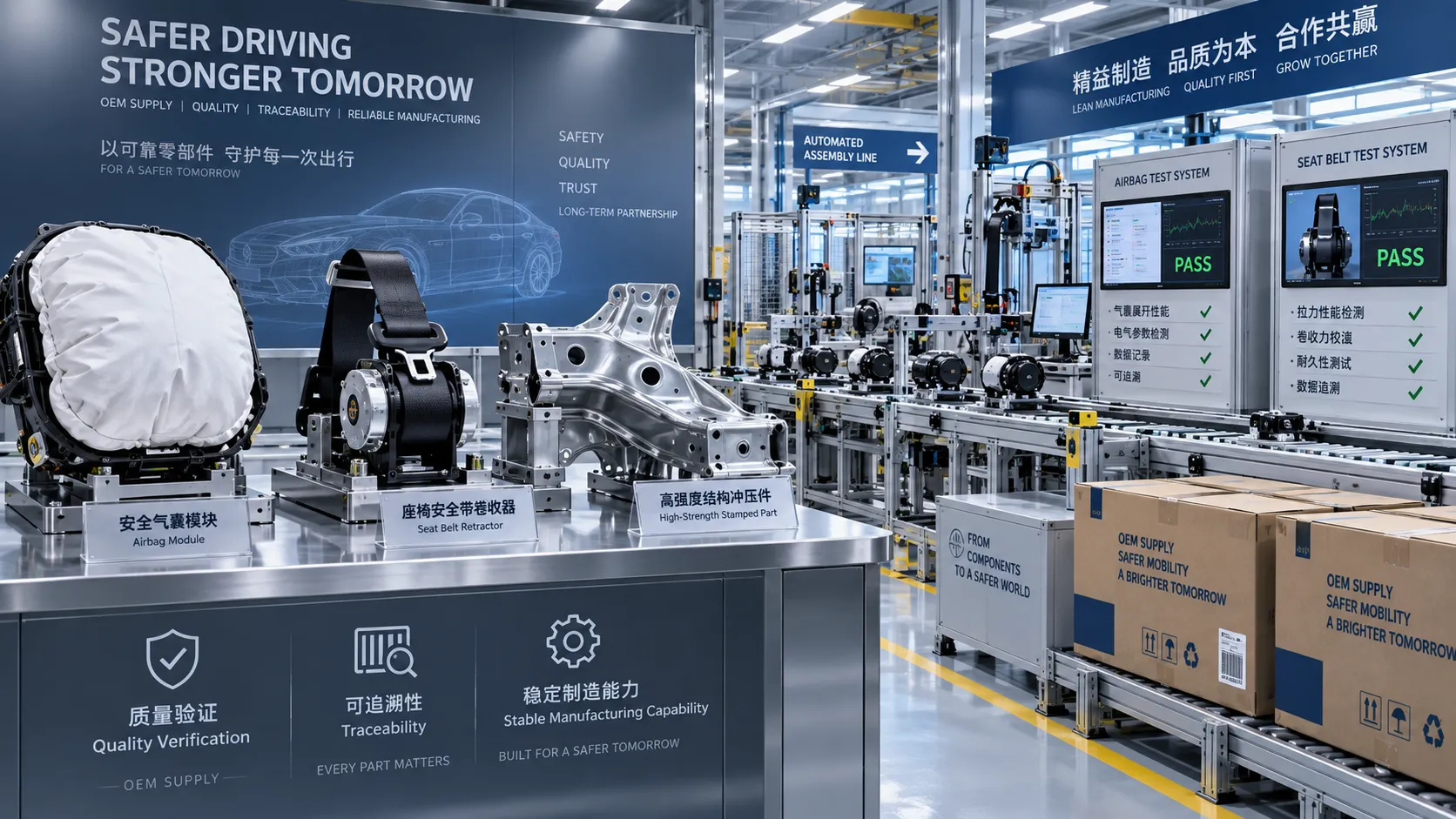
How to Evaluate a Crash Safety Components Exporter for Global OEM Supply Programs
Choose a crash safety components exporter with proven certification, traceability, testing, and OEM launch support. Use this guide to reduce global supply risk.
Related News
- 00
0000-00
How Rear-Impact Safety Components Work Together to Protect Vehicle Occupants - 00
0000-00
Crash Test Regulations for Seatbelts: Key Compliance Requirements Explained - 00
0000-00
How Seat Belt Pretensioners for EVs Improve Crash Safety and System Response - 00
0000-00
How Do Seatbelt Systems with Pretensioner Improve Crash Protection? - 00
0000-00
How Seatbelt Technology for Buses Improves Passenger Safety and Meets Compliance Needs
Weekly Insights
Stay ahead with our curated technology reports delivered every Monday.