
Crash Test Standards Explained: What OEMs and Suppliers Must Verify Before Approval
Why do crash test standards decide approval so early?
Crash test standards are not only a final gate. They shape design targets, supplier timing, and evidence plans from the first program review.
That matters because OEM approval rarely depends on one dramatic full-vehicle test. More often, it depends on a chain of verified assumptions.
If material data is weak, component behavior drifts. If component behavior drifts, system-level correlation becomes fragile. That is where launch risk begins.
In practice, crash test standards connect laboratory evidence with real integration decisions. They tell teams what must survive, deform, trigger, restrain, or absorb energy within defined limits.
Across mobility sectors, this logic is broader than passenger cars alone. GNCS often tracks how safety validation links lightweight bodies, restraint systems, and smart seating into one approval story.
The same discipline also explains why regulators, OEMs, and Tier suppliers focus on traceable data rather than optimistic simulation slides.
What do crash test standards actually require teams to verify?
A common misunderstanding is that crash test standards only describe impact speed and dummy injury limits. They go much deeper than that.
Before approval, verification usually spans material behavior, manufacturing stability, sub-system timing, occupant restraint performance, and full-vehicle or full-cabin correlation.
For hot-stamped structures, teams check yield behavior, thickness consistency, weld performance, and energy absorption after forming. Lightweighting only helps when deformation remains predictable.
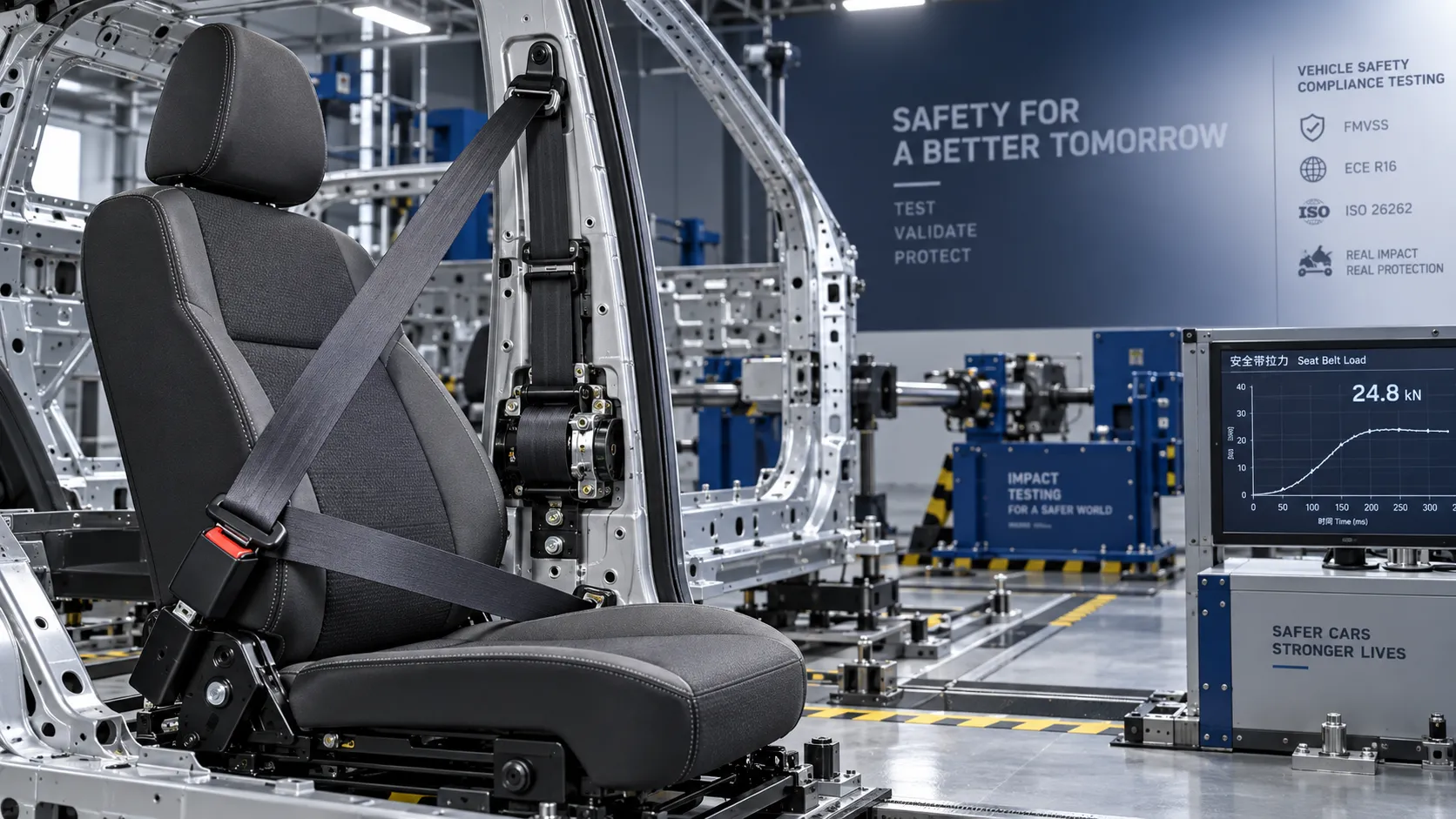
For airbags, seatbelts, and seat structures, the focus shifts to trigger timing, load paths, pretensioning response, force limiting, anchorage integrity, and occupant kinematics.
For seat assemblies, crash test standards also intersect with posture, sensor calibration, and structural retention. A comfortable seat that changes occupant position too much can create injury risk.
The table below helps frame the most common approval checks.
Which standards and test paths usually matter most?
The answer depends on market entry, platform type, and safety architecture. Not every program follows the same route, even when the keyword is simply crash test standards.
Regulatory standards establish legal entry. Consumer rating programs often create tougher design pressure. OEM internal requirements can be stricter than both.
That is why teams compare FMVSS, UNECE, NCAP protocols, IIHS methods, and brand-specific test books together rather than one by one.
A restraint supplier may pass a legal requirement but still miss an OEM pulse corridor or sensor response window. Approval can still stop there.
More advanced programs also watch adjacent signals. For example, GNCS intelligence frequently connects evolving crash test standards with lightweight body strategy, inflator chemistry changes, and seat-frame mass reduction.
This broader view matters because one compliance change often shifts several engineering assumptions at once.
- Legal compliance asks: can the product enter the market?
- Consumer ratings ask: will it remain competitive in public safety scoring?
- OEM standards ask: does it behave reliably inside a specific platform architecture?
Where do approval programs usually slip, even when the design looks ready?
Most delays do not come from not knowing crash test standards exist. They come from underestimating verification depth and timing.
One frequent issue is treating CAE correlation as a documentation step. In reality, poor correlation is an early warning that hardware, material cards, or boundary conditions are unstable.
Another issue appears during engineering changes. A small gauge reduction, bracket move, or trim change may alter dummy readings more than expected.
Seat-integrated safety systems are especially sensitive. Cushion stiffness, occupant position, recliner behavior, and belt path can interact in ways that are easy to miss in isolated tests.
There is also a supplier-side trap: passing component tests while missing integration evidence. OEM approval depends on how the part behaves in the vehicle, not only on its bench results.
The most useful risk review is usually simple and direct.
- Are material properties locked across expected production lots?
- Do sled tests match the latest restraint and seat geometry?
- Have sensor, inflator, and belt events been time-aligned with current pulses?
- Does every design change trigger a defined revalidation rule?
- Is there one approval matrix used by engineering, quality, and manufacturing?
How should verification be planned to protect timing and cost?
The practical answer is to build evidence in layers. Waiting for a final crash event to reveal system truth is expensive and avoidable.
Start with material and coupon data that truly reflects intended production processes. Then move to component tests, sled work, and only then depend on final system confirmation.
This staged method makes crash test standards manageable because each level answers a different question. Material tests explain capability. Component tests explain local behavior. System tests explain interaction.
A useful planning habit is to separate mandatory evidence from confidence-building evidence. Both matter, but they serve different decisions.
When this structure is missing, cost rises in a familiar way: more repeat tests, more late tooling changes, and less confidence in release timing.
What is the smartest next step before asking for approval?
The smartest next step is not another presentation. It is a clear approval map tied to actual crash test standards, evidence owners, and change-control rules.
That map should show which requirements are legal, which are OEM-specific, which are rating-driven, and which depend on platform integration assumptions.
It should also identify where confidence is still thin. For example, material variability, seat-belt geometry drift, inflator response margins, or incomplete CAE-to-test correlation.
In practical terms, strong programs treat crash test standards as a living validation framework rather than a test-day checklist.
That approach fits the wider GNCS view of safety and perception: reliable approval comes from stitching design, manufacturing, compliance, and real-world behavior into one verified chain.
If the goal is smooth approval, begin by reviewing requirement sources, correlation quality, and revalidation triggers. Those three checks usually reveal what needs attention next.
Related News

How to Specify Integrated Marine Electronics for Reliable Bridge Operations
Integrated marine electronics: learn how to specify reliable bridge systems with clear data flows, redundancy, alarm control, lifecycle interfaces, and operational testing.

How to Evaluate Navigation Radar Manufacturers for Commercial Vessel Projects
Navigation radar manufacturers: learn how to compare performance, compliance, integration, support, and lifecycle cost for commercial vessel projects.

How Adjustable Cabin Ergonomics Reduce Operator Fatigue in Long-Shift Vehicles
Adjustable cabin ergonomics reduces operator fatigue through better seating, reach, visibility, vibration control, and climate comfort for safer long-shift vehicles.

How Rear-Impact Safety Components Work Together to Protect Vehicle Occupants
Explore how automotive safety components for rear impact work together—from crash structures and seats to head restraints and belts—to enhance occupant protection.

How to Evaluate a Marine Safety Systems Manufacturer for Vessel Compliance and Reliability
Marine safety systems manufacturer evaluation guide: verify compliance, engineering quality, lifecycle costs, and global service support for safer, reliable vessel operations.
Crash Test Regulations for Seatbelts: Key Compliance Requirements Explained
Crash test regulations seatbelts explained: explore FMVSS, UN rules, anchorage strength, and dynamic restraint testing for safer, compliant vehicle systems.

How to Calculate the Total Cost of Automotive Lightweighting for a Vehicle Program
Automotive lightweight solutions cost: learn how to calculate program-level costs, including materials, tooling, joining, validation, risk, and vehicle-level value.

How Automotive Seat Occupancy Sensing Improves Airbag Deployment Decisions
Automotive seat occupancy sensing helps optimize airbag deployment decisions, improving passenger classification, safety diagnostics, and compliance across real-world conditions.

What Drives Lightweight Body Component Costs in High-Volume Vehicle Programs?
Lightweight body components cost depends on material yield, forming, joining, tooling, validation, and logistics. Explore proven ways to optimize total vehicle program cost.
Related News
- 00
0000-00
How to Specify Integrated Marine Electronics for Reliable Bridge Operations - 00
0000-00
How Adjustable Cabin Ergonomics Reduce Operator Fatigue in Long-Shift Vehicles - 00
0000-00
How to Evaluate a Marine Safety Systems Manufacturer for Vessel Compliance and Reliability - 00
0000-00
How to Calculate the Total Cost of Automotive Lightweighting for a Vehicle Program - 00
0000-00
What Drives Lightweight Body Component Costs in High-Volume Vehicle Programs?
Weekly Insights
Stay ahead with our curated technology reports delivered every Monday.