
Crash Test Regulations Explained: Key Standards, Ratings, and Compliance Checks
Why do crash test regulations matter so early in development?
Crash test regulations shape design long before a prototype reaches a lab. They influence body structure, restraint systems, seating geometry, labeling, traceability, and validation timing.
In practical terms, late attention creates expensive rework. A seat frame may pass comfort checks, yet fail injury criteria once belt loads and airbag timing are evaluated together.
That is why crash test regulations are not only legal requirements. They are program control tools that affect launch risk, supplier coordination, and change management.
Across global mobility sectors, the same discipline applies. GNCS often tracks how safety rules connect structural energy management, occupant containment, and data-backed compliance decisions.
For teams working with lightweight stampings, airbags, seatbelts, and smart seats, that connection is especially important. A single regulation gap can ripple across several subsystems.
Which standards and ratings are people usually referring to?
This is one of the most common points of confusion. Crash test regulations, legal standards, and consumer ratings are related, but they are not the same thing.
Legal compliance usually comes from government rules. In the United States, FMVSS requirements are central. In Europe, UNECE regulations are widely referenced.
Consumer information programs, such as Euro NCAP or IIHS, are different. They are not always mandatory, yet they strongly influence market acceptance and design targets.
A product can be technically compliant and still perform below expectations in a public rating. That gap often affects brand trust, sourcing pressure, and redesign budgets.
A simple comparison helps separate the layers.
The better approach is to map all three layers together. That prevents teams from passing certification while missing commercial expectations.
How do crash test regulations affect body, seat, belt, and airbag decisions?
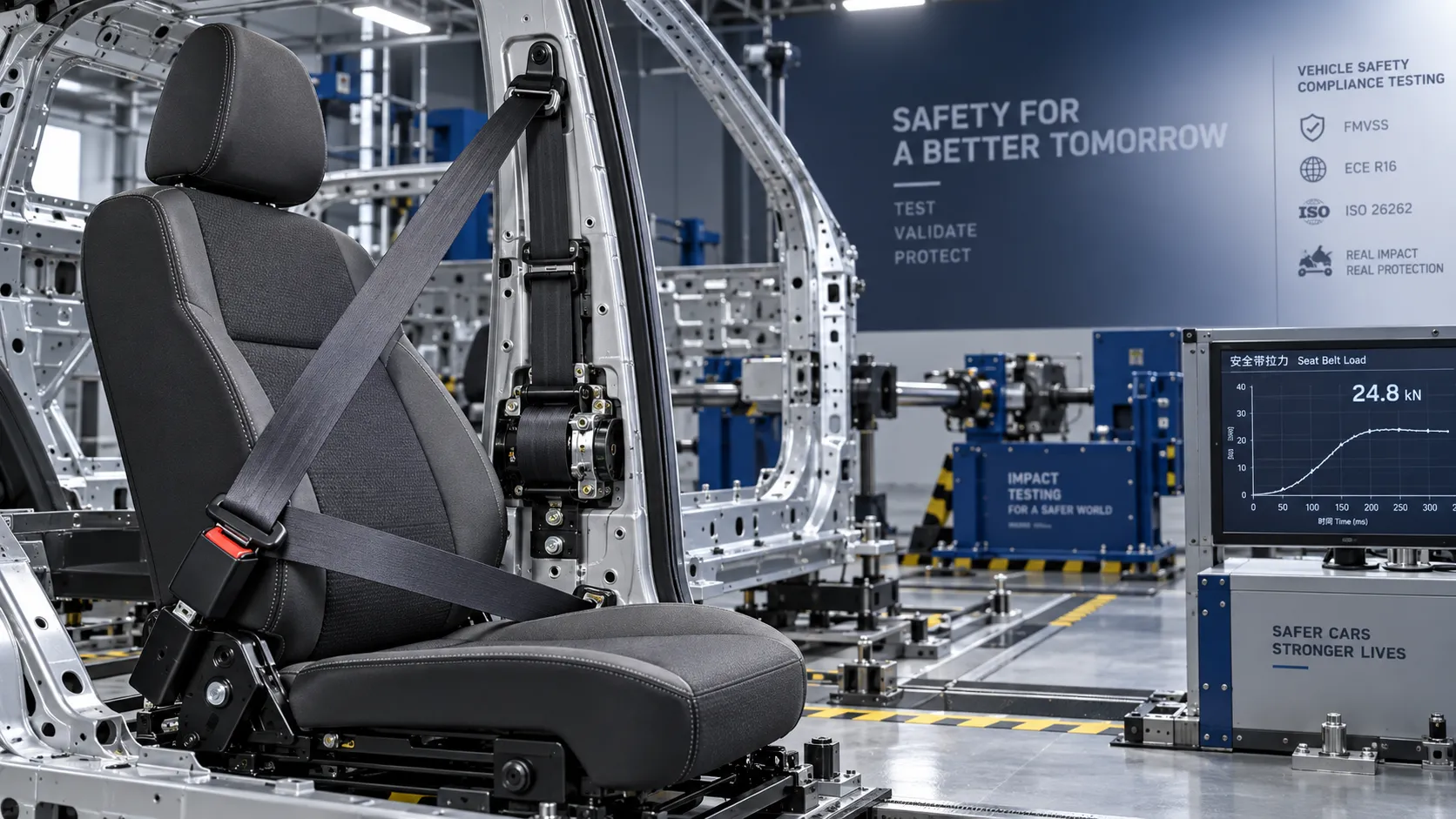
They rarely affect one part in isolation. Crash test regulations evaluate system behavior, so structural parts and restraint components must work as one controlled response.
Take lightweight body stampings as an example. Higher strength materials can improve intrusion resistance, but stiffness changes may alter load paths and occupant kinematics.
Seatbelt systems then need matching pretensioner and load limiter strategies. If belt force management is not aligned, chest loads or pelvis movement may exceed acceptable thresholds.
Airbag assemblies add another layer. Deployment timing, venting behavior, and inflator chemistry all influence how energy is absorbed during the impact event.
Seats also carry more compliance weight than many schedules assume. Frame stiffness, head restraint geometry, anchorage integrity, and sensor integration can change test outcomes significantly.
GNCS follows these cross-domain interactions closely because modern compliance is increasingly about integration, not component-level optimism.
- Body structure affects intrusion, deceleration pulse, and load transfer.
- Seatbelts control occupant position before peak impact loading.
- Airbags manage contact energy after occupant motion begins.
- Seats and anchors maintain posture, containment, and belt geometry.
When these decisions are reviewed together, compliance planning becomes more stable and less reactive.
What does a solid compliance check actually include?
A strong compliance check is more than booking a test slot. It combines requirement mapping, engineering evidence, supplier records, and test readiness reviews.
One useful way to think about crash test regulations is through checkpoints. Each checkpoint reduces uncertainty before expensive validation starts.
More common failures happen in paperwork and configuration control than in pure engineering. An untracked material revision can invalidate a carefully planned compliance result.
That is why mature programs treat crash test regulations as both a technical and documentation discipline.
Where do programs usually slip, even when the design looks good?
The first trap is assuming a previous platform result will carry over. Small geometry, mass, or restraint changes can break correlation very quickly.
Another frequent issue is chasing public ratings too late. If IIHS or Euro NCAP updates a protocol, timing pressure can force redesign under poor schedule conditions.
There is also a supplier-side risk. Parts may meet drawing dimensions, yet variation in weld quality, inflator performance, or pretensioner response can shift test results.
For global programs, market overlap creates another challenge. Crash test regulations differ in details, so one validation plan rarely fits every launch region without adjustment.
- Do not treat CAE correlation as a one-time milestone.
- Do not separate structural and restraint decisions in different timing tracks.
- Do not ignore revision control on materials, software, or calibration records.
- Do not assume consumer ratings follow the same pass logic as legal standards.
The better pattern is early convergence. Align targets, lab methods, and supplier evidence before physical validation becomes the only source of truth.
How should teams prepare for changing crash test regulations?
The short answer is to build a regulatory watch process, not a last-minute reaction process. Standards evolve, ratings evolve faster, and validation plans must absorb both.
In actual programs, the smartest move is usually a living compliance matrix. It should link market scope, applicable clauses, design owners, evidence status, and test timing.
It also helps to watch adjacent technology signals. GNCS often highlights how material changes, inflator chemistry updates, or smart seat sensing trends can reshape compliance assumptions.
This matters beyond passenger cars. Safety logic increasingly crosses marine electronics, cabin systems, and connected mobility equipment, where perception and protection need tighter coordination.
If the next step is unclear, start with a focused review:
- List all target markets and applicable crash test regulations.
- Check which ratings influence commercial acceptance.
- Review body, belt, airbag, and seat interfaces together.
- Confirm traceability for every compliance-critical change.
- Set review gates before prototype, sled, and full crash events.
Crash test regulations are easiest to manage when they are translated into clear decisions early. That reduces surprises, protects launch timing, and creates stronger confidence at release.
Related News

How to Specify Integrated Marine Electronics for Reliable Bridge Operations
Integrated marine electronics: learn how to specify reliable bridge systems with clear data flows, redundancy, alarm control, lifecycle interfaces, and operational testing.

How to Evaluate Navigation Radar Manufacturers for Commercial Vessel Projects
Navigation radar manufacturers: learn how to compare performance, compliance, integration, support, and lifecycle cost for commercial vessel projects.

How Adjustable Cabin Ergonomics Reduce Operator Fatigue in Long-Shift Vehicles
Adjustable cabin ergonomics reduces operator fatigue through better seating, reach, visibility, vibration control, and climate comfort for safer long-shift vehicles.

How Rear-Impact Safety Components Work Together to Protect Vehicle Occupants
Explore how automotive safety components for rear impact work together—from crash structures and seats to head restraints and belts—to enhance occupant protection.

How to Evaluate a Marine Safety Systems Manufacturer for Vessel Compliance and Reliability
Marine safety systems manufacturer evaluation guide: verify compliance, engineering quality, lifecycle costs, and global service support for safer, reliable vessel operations.
Crash Test Regulations for Seatbelts: Key Compliance Requirements Explained
Crash test regulations seatbelts explained: explore FMVSS, UN rules, anchorage strength, and dynamic restraint testing for safer, compliant vehicle systems.

How to Calculate the Total Cost of Automotive Lightweighting for a Vehicle Program
Automotive lightweight solutions cost: learn how to calculate program-level costs, including materials, tooling, joining, validation, risk, and vehicle-level value.

How Automotive Seat Occupancy Sensing Improves Airbag Deployment Decisions
Automotive seat occupancy sensing helps optimize airbag deployment decisions, improving passenger classification, safety diagnostics, and compliance across real-world conditions.

What Drives Lightweight Body Component Costs in High-Volume Vehicle Programs?
Lightweight body components cost depends on material yield, forming, joining, tooling, validation, and logistics. Explore proven ways to optimize total vehicle program cost.
Related News
- 00
0000-00
How to Specify Integrated Marine Electronics for Reliable Bridge Operations - 00
0000-00
How Adjustable Cabin Ergonomics Reduce Operator Fatigue in Long-Shift Vehicles - 00
0000-00
How to Evaluate a Marine Safety Systems Manufacturer for Vessel Compliance and Reliability - 00
0000-00
How to Calculate the Total Cost of Automotive Lightweighting for a Vehicle Program - 00
0000-00
What Drives Lightweight Body Component Costs in High-Volume Vehicle Programs?
Weekly Insights
Stay ahead with our curated technology reports delivered every Monday.