
Maritime Compliance Standards for New Projects: Common Gaps and How to Avoid Rework
Maritime Compliance Standards for New Projects: Common Gaps and How to Avoid Rework
For project managers launching new vessel or marine system programs, maritime compliance standards often look straightforward at kickoff.
Then reality shows up through drawings, interfaces, approvals, and sea trial deadlines.
A missing note, wrong test sequence, or late document update can create weeks of avoidable rework.
That is why maritime compliance standards should be treated as a live project control system, not a final checklist.
The good news is that most failures follow familiar patterns, and they can be prevented early with better structure.
Why compliance gaps appear so early
Most new programs begin with pressure on delivery dates, supplier alignment, and cost targets.
In that environment, maritime compliance standards are often divided into separate workstreams.
Engineering reads class rules.
Procurement checks vendor declarations.
Quality tracks records.
But no one fully owns the connection between design intent, evidence, and approval timing.
This becomes even harder when navigation systems, power systems, safety equipment, and software updates all interact.
A compliant component does not guarantee a compliant integrated vessel.
Common gap #1: treating rules as static
One of the biggest mistakes is assuming maritime compliance standards stay fixed after concept approval.
They do not.
Class interpretations change.
Flag-state expectations shift.
Cyber, software, and electronic navigation requirements evolve faster than many hardware teams expect.
When the project works from an outdated requirement set, redesign starts late and costs more.
How to avoid it:
- Create a controlled compliance register at project launch.
- Assign one owner for each rule source and revision date.
- Review regulatory updates at every design gate.
- Log interpretation questions early with class and authority contacts.
Common gap #2: missing the interface between systems
Many teams manage equipment compliance by item number.
That sounds efficient, but maritime compliance standards often fail at the interface level.
Think power quality, EMC, antenna placement, bridge visibility, alarm logic, cable routing, or software version compatibility.
Each single box may pass, yet the combined installation can still fail survey or sea trial validation.
Typical warning signs include:
- Late changes to cable lengths or mounting locations.
- Different suppliers using different interface assumptions.
- No integrated FAT or HAT scenario planning.
- Bridge layout approved before final equipment footprint freeze.
A better approach is simple:
- Map every critical system interface.
- Link each interface to applicable maritime compliance standards.
- Test the interface, not just the equipment.
Common gap #3: documentation that lags behind design
Rework often begins in document control long before anyone notices a technical problem.
A revised drawing may never reach the test pack.
A supplier certificate may reference an old model variant.
A software release note may not match the installed configuration.
Under maritime compliance standards, evidence quality matters as much as engineering quality.
In practical terms, approvals slow down when surveyors must chase basic traceability.
That delay usually lands at the worst possible moment.
To stay ahead:
- Use one document matrix for drawings, certificates, manuals, and test records.
- Tie every submission item to a system tag and revision number.
- Check supplier evidence before installation, not before delivery only.
- Freeze approval packages ahead of survey milestones.
Common gap #4: late testing strategy
Another common issue is treating testing as an execution activity instead of a planning activity.
That creates a chain reaction.
Test procedures get written too late.
Acceptance criteria stay vague.
And failed tests expose design assumptions that should have been challenged months earlier.
For maritime compliance standards, testing should mirror the approval path from lab to dock to sea.
When that path is clear, teams know what must be proven, by whom, and in which sequence.
Build the strategy around these checkpoints:
- Type approval and certificate validity.
- Factory Acceptance Test coverage.
- Harbor Acceptance Test integration scenarios.
- Sea trial criteria linked to maritime compliance standards.
- Retest triggers after design or software changes.
Common gap #5: suppliers are aligned commercially, not technically
A supplier may confirm compliance in a quotation, yet still miss project-specific obligations.
This happens often with integration documents, software baselines, or approval scope boundaries.
The result is a dangerous gap between contractual confidence and technical readiness.
From a project view, this is where maritime compliance standards need sharper supplier governance.
Not more meetings, just clearer proof points.
Useful controls include:
- A supplier compliance requirements sheet in every PO package.
- Mandatory review of certificates, limitations, and installation conditions.
- Joint review of interface drawings before fabrication release.
- A hold point for software and hardware configuration confirmation.
A practical framework to reduce rework
If rework keeps happening, the fix is rarely one more checklist.
The fix is a tighter operating rhythm around maritime compliance standards.
A simple framework can make that manageable.
1. Start with a compliance architecture
List class rules, flag requirements, owner specifications, and equipment approvals in one structure.
Then connect them to systems, interfaces, documents, and tests.
2. Review compliance at every gate
Do not wait for final approval reviews.
Check maritime compliance standards during concept, design freeze, procurement release, installation, and trials.
3. Track open risks visibly
Keep a live list of unresolved interpretations, missing evidence, and pending authority responses.
If a risk can block approval, it should never stay hidden in email.
4. Use change control with teeth
Small engineering changes can create major compliance impact.
Every change should answer one question: does this affect maritime compliance standards, evidence, or retesting needs?
Final takeaway
Most compliance rework is not caused by complex rules alone.
It comes from poor timing, weak interfaces, and incomplete traceability.
When maritime compliance standards are embedded into planning, supplier control, documentation, and testing, projects move with fewer surprises.
That means less redesign, faster approvals, and better confidence at handover.
For any new marine program, the smartest move is to make compliance visible early, verify it often, and treat evidence like part of the product itself.
Related News

How to Specify Integrated Marine Electronics for Reliable Bridge Operations
Integrated marine electronics: learn how to specify reliable bridge systems with clear data flows, redundancy, alarm control, lifecycle interfaces, and operational testing.

How to Evaluate Navigation Radar Manufacturers for Commercial Vessel Projects
Navigation radar manufacturers: learn how to compare performance, compliance, integration, support, and lifecycle cost for commercial vessel projects.

How Adjustable Cabin Ergonomics Reduce Operator Fatigue in Long-Shift Vehicles
Adjustable cabin ergonomics reduces operator fatigue through better seating, reach, visibility, vibration control, and climate comfort for safer long-shift vehicles.

How Rear-Impact Safety Components Work Together to Protect Vehicle Occupants
Explore how automotive safety components for rear impact work together—from crash structures and seats to head restraints and belts—to enhance occupant protection.
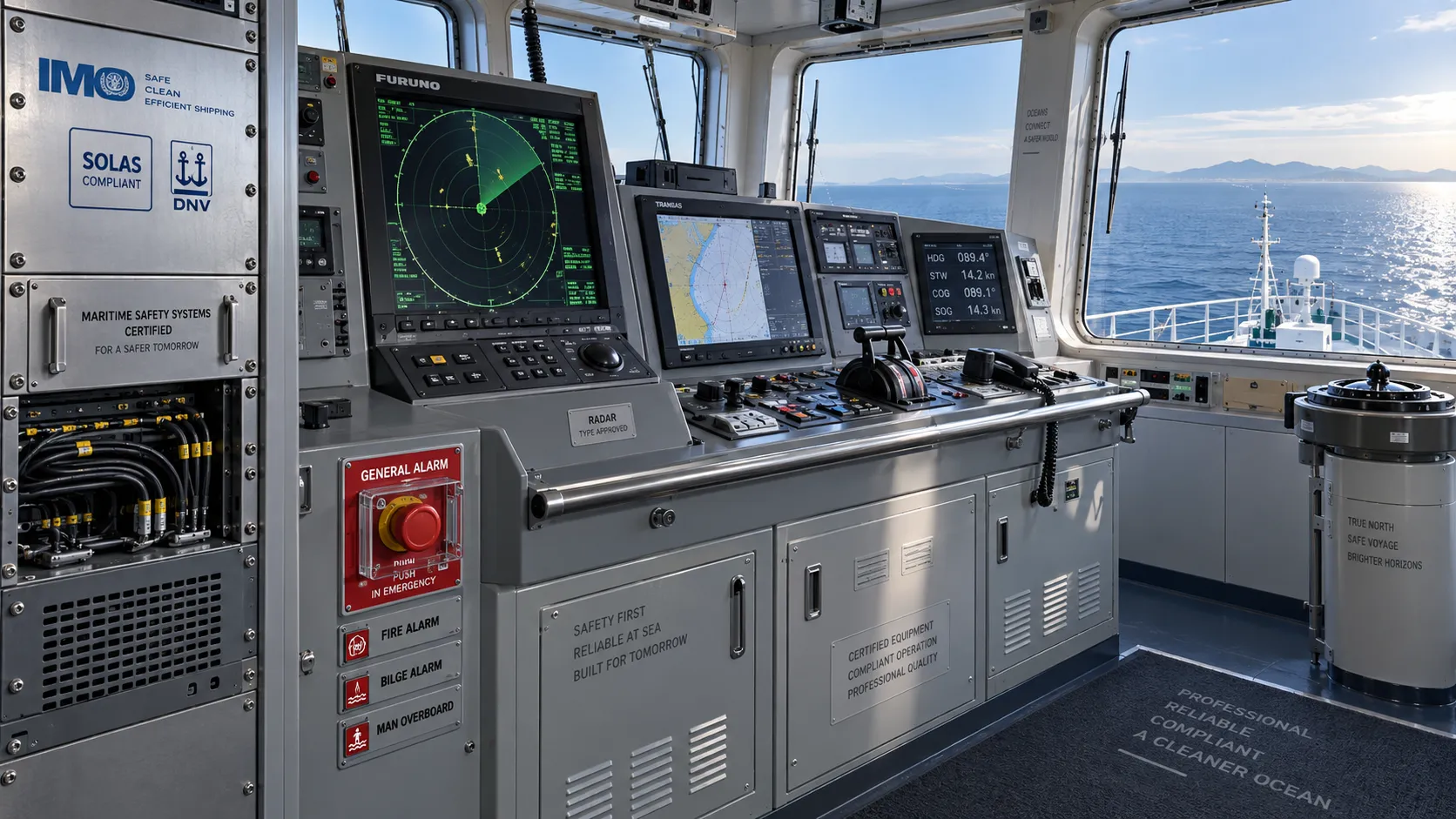
How to Evaluate a Marine Safety Systems Manufacturer for Vessel Compliance and Reliability
Marine safety systems manufacturer evaluation guide: verify compliance, engineering quality, lifecycle costs, and global service support for safer, reliable vessel operations.

Crash Test Regulations for Seatbelts: Key Compliance Requirements Explained
Crash test regulations seatbelts explained: explore FMVSS, UN rules, anchorage strength, and dynamic restraint testing for safer, compliant vehicle systems.

How to Calculate the Total Cost of Automotive Lightweighting for a Vehicle Program
Automotive lightweight solutions cost: learn how to calculate program-level costs, including materials, tooling, joining, validation, risk, and vehicle-level value.

How Automotive Seat Occupancy Sensing Improves Airbag Deployment Decisions
Automotive seat occupancy sensing helps optimize airbag deployment decisions, improving passenger classification, safety diagnostics, and compliance across real-world conditions.

What Drives Lightweight Body Component Costs in High-Volume Vehicle Programs?
Lightweight body components cost depends on material yield, forming, joining, tooling, validation, and logistics. Explore proven ways to optimize total vehicle program cost.
Related News
- 00
0000-00
How to Specify Integrated Marine Electronics for Reliable Bridge Operations - 00
0000-00
How Adjustable Cabin Ergonomics Reduce Operator Fatigue in Long-Shift Vehicles - 00
0000-00
How to Evaluate a Marine Safety Systems Manufacturer for Vessel Compliance and Reliability - 00
0000-00
How to Calculate the Total Cost of Automotive Lightweighting for a Vehicle Program - 00
0000-00
What Drives Lightweight Body Component Costs in High-Volume Vehicle Programs?
Weekly Insights
Stay ahead with our curated technology reports delivered every Monday.