
How to Qualify an Airbag Modules Supplier for OEM Safety and Delivery Requirements
How to Qualify an Airbag Modules Supplier for OEM Safety and Delivery Requirements
Choosing an airbag modules supplier is not a routine sourcing exercise. A module may look like a defined bill of materials—cushion, inflator, housing or cover, connectors, brackets, labels, and sometimes integrated electronics—but its performance is judged in milliseconds and under conditions that cannot be corrected after vehicle launch. A low quotation can become very expensive if the supplier cannot maintain deployment consistency, document a material change, or keep an assembly line supplied during a disruption.
For OEM and Tier 1 procurement teams, the real question is not whether a supplier can manufacture a sample module. It is whether that supplier can repeatedly deliver a validated safety product through prototype, launch ramp-up, serial production, service parts, and end-of-production obligations. That requires a qualification process that connects engineering evidence, quality discipline, commercial terms, and logistics reality.
In passive safety, the module also cannot be assessed in isolation. Its behavior depends on vehicle architecture, restraint control strategy, seat position, belt system, trim geometry, body crash pulse, and occupant protection targets. Buyers who understand this relationship tend to ask better questions early—and avoid discovering interface risks after tooling has been committed.
Start by Defining What the Supplier Is Actually Responsible For
“Airbag module” can mean different things across programs. One supplier may provide a complete driver airbag module ready for steering-wheel integration. Another may assemble an inflator and folded cushion into a housing supplied by the customer. Side airbags, curtain airbags, knee airbags, and passenger modules each introduce different packaging, deployment, trim, and storage considerations.
Before comparing suppliers, procurement should align with safety engineering and program management on the responsibility boundary. The sourcing package should clarify who owns the design, who nominates the inflator source, who validates the cushion folding method, who controls critical software or electronics where applicable, and who carries liability for interface changes. Ambiguity here often produces misleading price comparisons. A supplier quoting only final assembly is not directly comparable with one taking responsibility for design validation, tooling, testing coordination, and warranty exposure.
This is particularly important when an OEM is pursuing lightweight cabin architecture. A lower-mass instrument panel beam, a revised seat frame, or a different trim substrate may change the airbag deployment environment. GNCS’s work across passive safety, body stampings, seat systems, and cabin integration highlights a practical point: restraint components are connected systems. A module supplier should be able to discuss those connections rather than treating its product as a sealed black box.
Look Beyond Certificates: Evaluate the Safety Quality System in Use
A current automotive quality certification is an important entry condition, but it should not end the review. Certificates confirm that a management system has been assessed within a stated scope; they do not prove that a particular production line is ready for a specific restraint program. The more useful inquiry is how the supplier manages special characteristics, prevents mixing of variants, contains suspect material, and escalates a potential safety issue.
During a supplier audit, ask to follow one module from incoming components to shipment. Can the team show lot-level links between the inflator, fabric cushion, initiator or connector, cover or housing, assembly station, operator record where relevant, inspection result, and shipping label? In a safety recall investigation, traceability has to work under pressure. A system that only works when the quality manager is present is not enough.
Also examine how changes are controlled. Inflator chemistry, fabric coating, sewing thread, adhesive, folded-cushion retention method, connector plating, and packaging conditions can all matter. The supplier should have a disciplined process for evaluating, documenting, approving, and communicating changes. Procurement should resist broad contractual language that permits “equivalent materials” without written customer approval. In passive safety, equivalent on paper may not be equivalent in the vehicle.
Validate Technical Capability at the Module and Vehicle Interface
A capable airbag modules supplier does not need to own every laboratory, but it must know which validation work is needed, where it will be performed, and how the results are controlled. Buyers should distinguish between component-level testing, module-level testing, and vehicle-level restraint validation. Each answers a different question.
For example, a module deployment test may confirm certain deployment characteristics under a defined setup, while a full vehicle crash assessment considers the actual cabin environment, occupant surrogate response, belt interaction, seat position, and crash pulse. Markets may refer to requirements and consumer-assessment protocols such as those used by regulatory authorities, IIHS, or Euro NCAP, but acceptance criteria must always be tied to the target market and the vehicle program’s approved validation plan. A supplier should never imply that one generic test makes a module globally compliant.
Ask how the supplier handles design and process risk analysis, how it defines critical product characteristics, and how test samples are selected and retained. Review the maturity of the tooling plan as well. Airbag cushions require controlled cutting, sewing, coating-related material handling, and repeatable folding. A supplier that can make hand-built prototype cushions may still struggle when production equipment must achieve stable folds at volume.
Inflator sourcing deserves special attention. The inflator is not merely a purchased part; it is a safety-critical subsystem with storage, handling, transport, and integration implications. Buyers should understand whether the module assembler has direct technical access to the inflator manufacturer, whether supply is dual-sourced or single-sourced, and who has authority to approve substitutions. If the supply chain crosses borders, transport classification and customs handling for relevant materials should be reviewed early rather than left to a logistics provider after nomination.
Treat Delivery Capacity as a Launch Risk, Not a Logistics Detail
Airbag supply failures are rarely caused by one obvious problem. They often begin with an overlooked dependency: a constrained inflator source, a specialized fabric mill, a cover molding tool with insufficient redundancy, an outsourced sewing operation, or a test station that becomes the bottleneck during ramp-up. A production-capacity presentation is useful, but it is only a starting point.
The better question is: what is the supplier’s proven output under the proposed mix, quality checks, shift model, scrap assumption, maintenance plan, and packaging cycle? Nameplate capacity can be technically true while remaining irrelevant to a launch schedule. Review cycle-time assumptions, bottleneck operations, buffer stock policy, and the time needed to recover from a quality hold. If the program includes left-hand-drive and right-hand-drive variants, multiple trim colors, regional labels, or several vehicle derivatives, ask how the supplier will prevent mix-ups without creating excessive inventory.
Geography matters as well. A plant near final assembly can reduce transit exposure, but proximity does not compensate for weak upstream control. Conversely, a well-managed regional supply network can be reliable if packaging validation, customs planning, emergency freight rules, and communication routines are already defined. Procurement should request a realistic business continuity plan covering power loss, equipment failure, labor disruption, cyber incidents, and interruption at key sub-suppliers. The goal is not to demand a perfect contingency for every event; it is to see whether the supplier has thought beyond normal production.
Compare Total Program Cost, Not Just Piece Price
The cheapest quotation may exclude the work that protects the launch. Cost comparison should separate recurring piece price from tooling, validation support, packaging, service-parts obligations, engineering changes, logistics, warranty allocation, and currency exposure. For long-running programs, the cost of maintaining obsolete tools or supporting low-volume service demand can be material even when it barely appears in the original sourcing decision.
A useful sourcing review asks what has been assumed rather than simply what has been quoted. Has the supplier priced the required production ramp? Are inflation or commodity adjustments defined? Does the quote assume customer-furnished inflators, covers, or electronic components? What happens if forecast volumes fall below the supplier’s economic run rate? These questions are commercial, but they are also operational. Suppliers under severe margin pressure may reduce experienced staffing, delay equipment maintenance, or become reluctant to fund corrective action.
There is a reasonable place for cost-down targets, especially where design commonality, manufacturing automation, packaging optimization, or regionalization can remove waste. But a cost-down discussion should not quietly weaken validation, traceability, or change approval discipline. Safety-related savings need an engineering rationale, not just a purchasing target.
Use the Supplier Audit to Test Behavior, Not Presentation Skills
A polished audit deck can hide a fragile operation. Spend time on the shop floor, in the material warehouse, at the rework area, and with the planners responsible for customer releases. Ask an operator to explain what happens when a connector does not seat correctly. Ask the quality team to retrieve records from an older shipment. Ask the production planner which purchased component would stop the line first if demand increased unexpectedly.
The answers need not be flawless. In fact, a supplier that openly identifies a constraint and presents a credible corrective plan is often easier to work with than one that claims no risk exists. Look for consistency between the commercial team, program manager, plant leadership, and technical staff. If each function describes a different scope, timing, or responsibility model, that misalignment will likely surface again during launch.
It is also worth checking the supplier’s experience with structured customer approval processes, documentation submissions, and launch readiness reviews. Specific terminology varies by OEM and region, but the underlying discipline is similar: production parts must be supported by evidence that the process can repeatedly make conforming product under normal operating conditions.
Nomination Should Be Conditional, Not Blind
The strongest sourcing decision is often a conditional nomination with clearly owned closure actions. Some issues must be resolved before tooling release; others can be managed before pilot build or production approval. Separate these categories. An unresolved inflator supply agreement, missing traceability architecture, or unclear responsibility for vehicle-level validation is usually not a minor follow-up item. A packaging-label refinement may be.
Keep the scorecard practical: technical fit, quality-system evidence, supply-chain resilience, manufacturing maturity, commercial transparency, and responsiveness during the qualification process. The final choice should not automatically go to the supplier with the highest score in one category. An airbag modules supplier is being selected to support a safety-critical program for years, often across changing vehicle configurations and market requirements. The supplier that offers credible evidence, clear ownership, and honest operating visibility is usually the safer commercial decision than one that simply presents the lowest initial number.
Related News
How to Specify Integrated Marine Electronics for Reliable Bridge Operations
Integrated marine electronics: learn how to specify reliable bridge systems with clear data flows, redundancy, alarm control, lifecycle interfaces, and operational testing.

How to Evaluate Navigation Radar Manufacturers for Commercial Vessel Projects
Navigation radar manufacturers: learn how to compare performance, compliance, integration, support, and lifecycle cost for commercial vessel projects.
How Adjustable Cabin Ergonomics Reduce Operator Fatigue in Long-Shift Vehicles
Adjustable cabin ergonomics reduces operator fatigue through better seating, reach, visibility, vibration control, and climate comfort for safer long-shift vehicles.

How Rear-Impact Safety Components Work Together to Protect Vehicle Occupants
Explore how automotive safety components for rear impact work together—from crash structures and seats to head restraints and belts—to enhance occupant protection.
How to Evaluate a Marine Safety Systems Manufacturer for Vessel Compliance and Reliability
Marine safety systems manufacturer evaluation guide: verify compliance, engineering quality, lifecycle costs, and global service support for safer, reliable vessel operations.
Crash Test Regulations for Seatbelts: Key Compliance Requirements Explained
Crash test regulations seatbelts explained: explore FMVSS, UN rules, anchorage strength, and dynamic restraint testing for safer, compliant vehicle systems.

How to Calculate the Total Cost of Automotive Lightweighting for a Vehicle Program
Automotive lightweight solutions cost: learn how to calculate program-level costs, including materials, tooling, joining, validation, risk, and vehicle-level value.
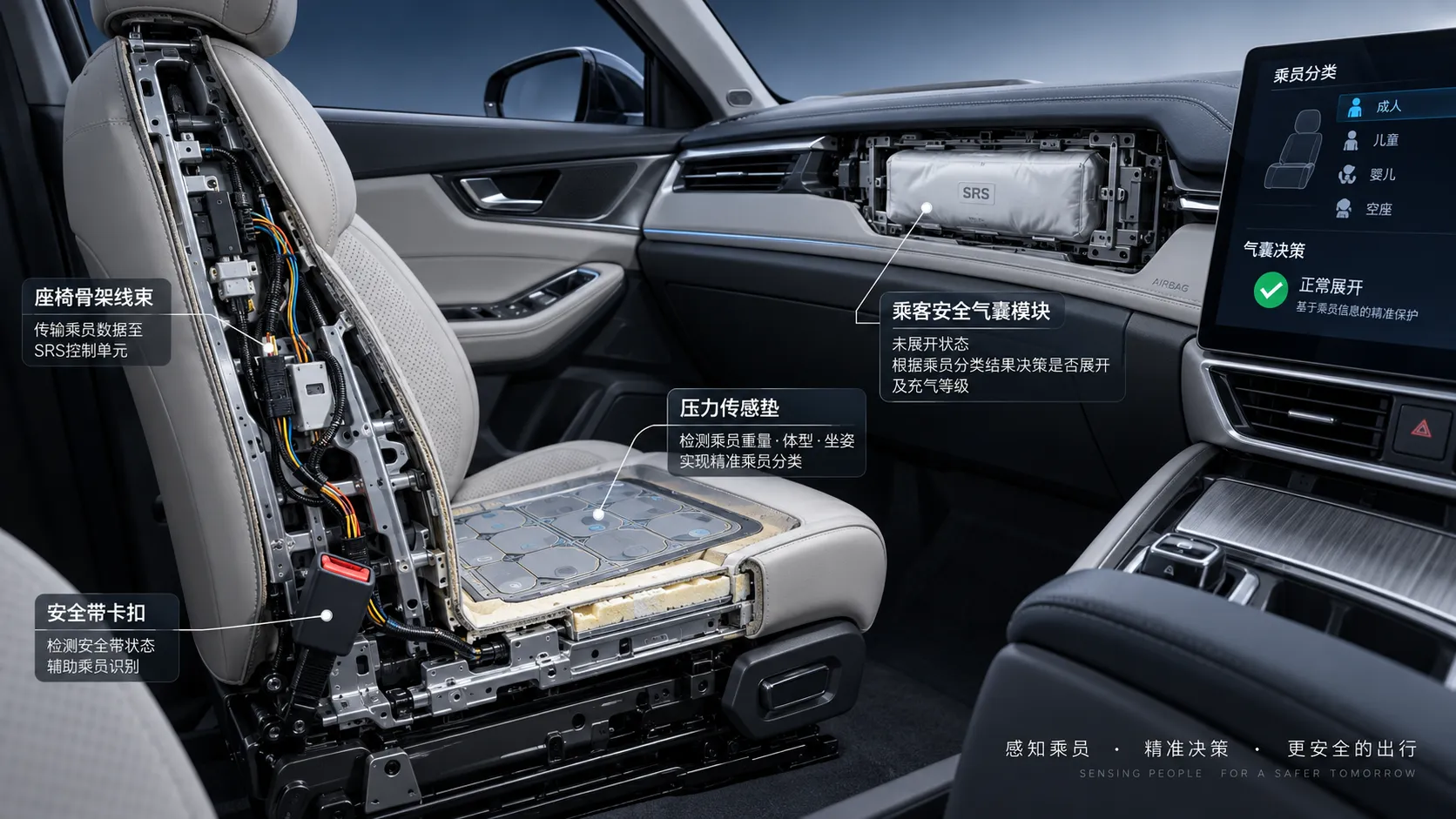
How Automotive Seat Occupancy Sensing Improves Airbag Deployment Decisions
Automotive seat occupancy sensing helps optimize airbag deployment decisions, improving passenger classification, safety diagnostics, and compliance across real-world conditions.

What Drives Lightweight Body Component Costs in High-Volume Vehicle Programs?
Lightweight body components cost depends on material yield, forming, joining, tooling, validation, and logistics. Explore proven ways to optimize total vehicle program cost.
Related News
- 00
0000-00
How Automotive Seat Occupancy Sensing Improves Airbag Deployment Decisions - 00
0000-00
How Smart Seating Sensors Improve Occupant Detection and Airbag Deployment - 00
0000-00
How to Qualify an Airbag Modules Supplier for OEM Safety and Delivery Requirements - 00
0000-00
How to Select Occupant Safety Systems for Vehicles Operating in the Middle East - 00
0000-00
Which Passive Safety Engineering Standards Apply to Automotive Restraint Systems?
Weekly Insights
Stay ahead with our curated technology reports delivered every Monday.