
How to Evaluate an Occupant Restraint Systems Exporter for Quality, Compliance, and Supply Risk
Meta Title: How to Evaluate an Occupant Restraint Systems Exporter for Quality, Compliance, and Supply Risk
If you are sourcing from an occupant restraint systems exporter, the real question is not who gives the lowest quote. It is who can keep you out of recall risk, shipment delays, and compliance trouble six months after the order is placed. In passive safety components, a cheaper unit price can become expensive very quickly if traceability is weak, test evidence is incomplete, or supply continuity depends on one fragile plant or one sub-supplier. A good exporter should reduce operational risk, not simply fill a purchase order.
That is why experienced buyers look past catalogs and sample approvals. They want to know whether the exporter can consistently deliver seatbelt systems, airbag-related assemblies, or other restraint components that meet program requirements, pass audits, and stay stable under production pressure. The evaluation has to cover quality discipline, certification integrity, engineering depth, and supply resilience at the same time.
Start with the part category, not the sales promise
“Occupant restraint systems” sounds broad, and that is exactly where many sourcing mistakes begin. An exporter may be strong in seatbelt hardware but weak in inflator-adjacent processes, webbing validation, or pretensioner integration support. Another may be competent in metal brackets and stamped reinforcements, yet rely heavily on outside partners for critical safety subassemblies.
Before comparing suppliers, define what you are actually buying:
- Complete seatbelt systems or only selected modules
- Buckles, retractors, pretensioners, anchors, or load limiters
- Airbag assemblies or airbag-related sewn and assembled components
- OE program supply, aftermarket supply, or service parts
- Prototype support, low-volume launch, or full-scale mass production
This sounds basic, but it changes everything. The right exporter for low-volume replacement parts may not be the right one for a regulated vehicle platform with strict PPAP, change control, and audit expectations.
A short answer buyers can use: choose an exporter only after verifying three things together: proven manufacturing control, valid compliance support for your target market, and a supply model that can survive disruption without changing quality.
How to assess an occupant restraint systems exporter beyond paperwork
Many exporters know how to prepare an impressive document pack. Fewer can show that the documents reflect daily factory behavior. That difference matters more than most buyers expect.
The first filter is quality management maturity. For safety-critical automotive components, buyers usually expect recognized quality certifications and a disciplined process culture. The certificate itself is not enough. Check scope, issuing body, covered manufacturing site, and validity period. A certificate covering “metal parts” does not automatically prove competence for sewn restraint assemblies, pyrotechnic-related handling, or end-of-line functional validation.
Then move into evidence that the system is alive, not decorative:
- Incoming material inspection standards for webbing, metal parts, fasteners, electronics, or sewn components
- Control plans tied to critical characteristics
- Lot traceability from raw material to finished shipment
- Calibration records for test and inspection equipment
- Nonconformance handling, containment, and corrective action discipline
- Engineering change control and customer approval flow
A useful test during supplier review is to ask for one recent quality incident, what happened, how containment was done, and what permanent corrective action was implemented. Serious exporters can answer this clearly. Weak ones usually hide behind general language about “continuous improvement.”
Compliance is not just a certificate folder
Procurement teams often get trapped by a false sense of safety here. A supplier sends test reports, declarations, and a list of standards, and the file looks complete. But restraint systems are exposed to market-specific requirements, customer-specific engineering standards, and documentation rules that can change by platform and destination.
So the practical question is not “Are you compliant?” It is “Compliant for which program, under which regulation set, with what supporting evidence, and who owns updates when rules or component revisions change?”
Ask the exporter to clarify:
- Which standards and regulations they routinely work with
- Whether validation was done internally, by third-party labs, or by the final OEM/Tier 1 customer
- How they manage material declarations, restricted substance compliance, and documentation refresh
- How they control product changes that may trigger revalidation
If your target markets involve crash-related or vehicle safety compliance, rely on official regulator requirements, OEM specifications, and customer program documents rather than supplier summaries alone. Where test claims are important, original reports and current approval status should be verified directly.
This is also where a specialist intelligence source can help. GNCS, for example, tracks passive safety components, seatbelt systems, airbag assemblies, lightweight body structures, and evolving crash-related compliance signals across the mobility sector. For buyers managing cross-border sourcing, that kind of monitoring is useful as a secondary reference point when supplier claims look technically plausible but need wider market context.
Testing capability tells you how the factory thinks
A supplier does not need to own every advanced test in-house to be credible. But they do need to know which tests matter, which characteristics are safety-critical, and how results feed back into production control.
When evaluating an exporter, look for testing logic, not just machine photos. Can they explain their validation flow? Do they separate design validation from routine production verification? Can they identify which checks happen per lot, per shift, or per launch stage?
For restraint-related products, buyers usually want to understand capabilities around mechanical performance, durability, locking or retraction behavior where applicable, material consistency, sewing integrity, corrosion resistance, and environmental reliability. Exact test requirements depend on the product category and customer specification, so the exporter should speak in program-specific terms rather than generic “we test everything” language.
If they outsource critical testing, that is not automatically a problem. The real issue is whether they control the process: lab qualification, sample selection, report traceability, retest triggers, and response to failed results.
Watch the supply chain behind the exporter
Some of the biggest sourcing failures come from suppliers that looked fine until demand increased, freight tightened, or a sub-tier source changed material. On paper, the exporter remained the same. In reality, the product and delivery risk changed underneath.
Ask direct questions about dependency:
- How many approved sources exist for critical materials and subcomponents?
- Which parts come from single-source suppliers?
- What is the backup plan if one plant stops or one country route is blocked?
- How much safety stock is held for long-lead items?
- Can they provide supply continuity plans for launch and peak demand periods?
Buyers sometimes focus too heavily on final assembly capacity and ignore sub-tier fragility. That is risky in occupant restraint products, where specialized webbing, precision springs, pyrotechnic-related components, sensors, and electronic subparts may have much tighter supply constraints than the finished assembly line itself.
If an exporter refuses to discuss sub-supplier risk at all, treat that as a warning sign.
Low price can hide expensive instability
A quote only makes sense when you understand what has been included, excluded, or quietly assumed. With an occupant restraint systems exporter, pricing gaps often show up in tooling maintenance, validation support, packaging standards, change management, warranty exposure, and logistics buffers.
Three exporters may offer similar part pricing, but the commercial risk can be very different:
- One includes structured launch support, traceability labels, and audit readiness
- One assumes annual volume that your program may never reach
- One prices aggressively because they depend on unstable external processing or underdeveloped inspection coverage
That is why total procurement cost matters more than piece price. Rework, late delivery, emergency freight, quarantine handling, customer chargebacks, and line stoppage exposure can erase apparent savings fast.
If the quote is unusually low, ask what process assumptions make that possible. The answer is often more valuable than the discount.
What a useful supplier audit actually looks like
Audit checklists have their place, but they are not enough on their own. A productive audit follows the product through the factory and asks practical questions at each stage.
Walk the material flow. Review traveler records. Check whether lot identity survives repacking or intermediate storage. Compare control plan requirements with what operators really inspect. Look at defect samples. Ask how suspect stock is isolated. Review maintenance discipline on fixtures and test equipment. Verify whether engineering revisions on the line match the latest approved level.
One of the simplest and most revealing checks is this: pick one shipped batch and ask the exporter to reconstruct its full history. A strong supplier can trace raw material, process records, inspection status, operator or machine link, and shipment destination without confusion. A weak supplier starts searching across disconnected spreadsheets and emails.
Common buying mistakes in restraint system sourcing
The first mistake is assuming that automotive-looking documentation equals automotive-grade control. It does not.
The second is overvaluing sample performance. A good sample proves the supplier can make one acceptable part. It does not prove they can hold process stability over months, shifts, and volume swings.
Another common miss is separating quality review from logistics review. In this category, they are linked. A supplier under delivery pressure may substitute materials, rush validation, skip preventive maintenance, or relax final checks. If you assess quality without understanding capacity stress, you are only seeing half the picture.
And one more: buyers sometimes avoid deeper technical conversations because they feel engineering should handle them. In restraint systems, procurement should stay involved. Commercial terms, lead times, alternate sourcing rights, quality response windows, and change notification clauses all sit directly inside the risk profile.
What good exporters usually do well
Dependable exporters are rarely the loudest. They are specific. They answer with records, not slogans. They can explain process limits, not just capabilities. They are careful about what they claim. If a requirement sits outside their validated scope, they say so early.
They also tend to be disciplined about changes. New material source? They document it. Fixture update? They assess impact. Packaging revision? They consider traceability and transit damage. That mindset is often a better signal than any sales presentation.
When you reach shortlist stage, ask each supplier for a risk map of your program: likely bottlenecks, compliance dependencies, tooling concerns, and launch risks. The best partner is not always the one promising zero problems. It is often the one that can identify the real problems before they hit your line.
Final decision: choose the exporter you can govern
The best occupant restraint systems exporter is not simply the cheapest, the biggest, or the fastest to quote. It is the supplier whose process you can understand, whose compliance position you can verify, and whose supply chain will not surprise you when market conditions tighten.
For procurement teams, that usually means a balanced decision: proven quality systems, honest technical scope, documented traceability, realistic pricing, and enough operational depth to keep your program stable. If one area remains vague, keep digging. In safety-critical sourcing, vagueness is rarely harmless.
FAQ
How do I verify whether an exporter’s certification is meaningful?
Check the certificate scope, issuing body, site name, validity, and whether it covers the actual product and process you plan to buy. Then confirm that shop-floor practice matches the documented system.
Is it acceptable if the exporter uses third-party labs for testing?
Yes, if the lab is appropriate for the required tests and the exporter controls sample traceability, report ownership, failure response, and revalidation triggers. Outsourcing tests is common; unmanaged outsourcing is the problem.
Should procurement care about sub-tier suppliers?
Yes. Many delivery and quality failures begin at the sub-tier level. Critical raw materials and specialized safety subcomponents can create more risk than final assembly capacity.
Can I approve a supplier based on samples and price alone?
That is a weak basis for approval in this category. Samples show product possibility, not long-run production discipline. Price without process visibility usually leaves hidden cost exposure.
Internal Link Anchor Text Suggestions
- seatbelt system supplier evaluation: supplier qualification or sourcing guide page
- airbag assembly compliance requirements: compliance knowledge base or technical insights page
- automotive passive safety components sourcing: category overview or buyer resource page
- how to audit automotive component exporters: supplier audit checklist or methodology page
- supply risk management for Tier 1 procurement: procurement strategy or market intelligence page
External Authority Source Directions
- government vehicle safety regulator pages and official compliance guidance
- recognized automotive quality management and standards bodies
- OEM or Tier 1 technical documentation for passive safety component requirements
Related News
How to Specify Integrated Marine Electronics for Reliable Bridge Operations
Integrated marine electronics: learn how to specify reliable bridge systems with clear data flows, redundancy, alarm control, lifecycle interfaces, and operational testing.

How to Evaluate Navigation Radar Manufacturers for Commercial Vessel Projects
Navigation radar manufacturers: learn how to compare performance, compliance, integration, support, and lifecycle cost for commercial vessel projects.
How Adjustable Cabin Ergonomics Reduce Operator Fatigue in Long-Shift Vehicles
Adjustable cabin ergonomics reduces operator fatigue through better seating, reach, visibility, vibration control, and climate comfort for safer long-shift vehicles.
How Rear-Impact Safety Components Work Together to Protect Vehicle Occupants
Explore how automotive safety components for rear impact work together—from crash structures and seats to head restraints and belts—to enhance occupant protection.
How to Evaluate a Marine Safety Systems Manufacturer for Vessel Compliance and Reliability
Marine safety systems manufacturer evaluation guide: verify compliance, engineering quality, lifecycle costs, and global service support for safer, reliable vessel operations.
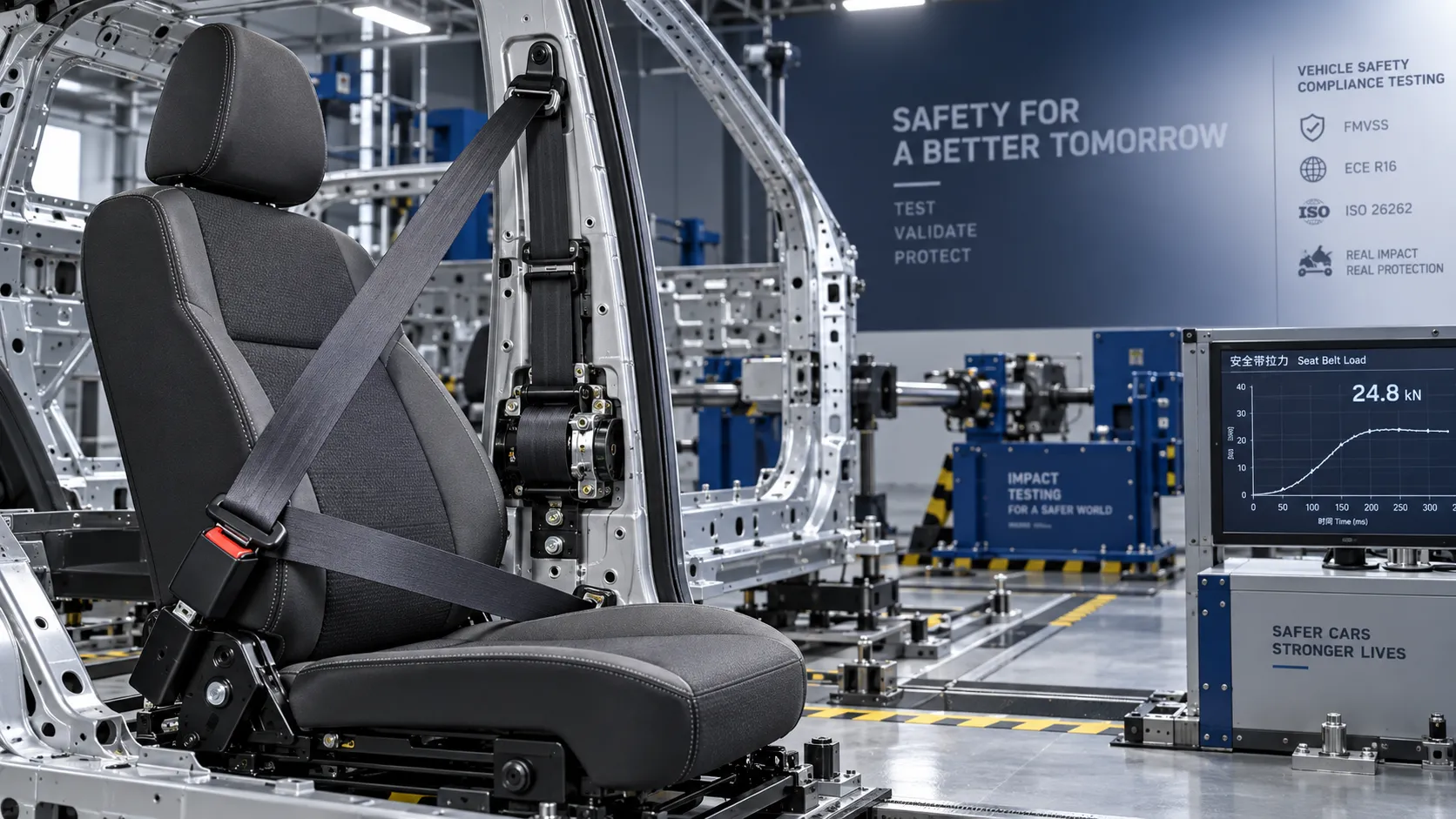
Crash Test Regulations for Seatbelts: Key Compliance Requirements Explained
Crash test regulations seatbelts explained: explore FMVSS, UN rules, anchorage strength, and dynamic restraint testing for safer, compliant vehicle systems.
How to Calculate the Total Cost of Automotive Lightweighting for a Vehicle Program
Automotive lightweight solutions cost: learn how to calculate program-level costs, including materials, tooling, joining, validation, risk, and vehicle-level value.

How Automotive Seat Occupancy Sensing Improves Airbag Deployment Decisions
Automotive seat occupancy sensing helps optimize airbag deployment decisions, improving passenger classification, safety diagnostics, and compliance across real-world conditions.
What Drives Lightweight Body Component Costs in High-Volume Vehicle Programs?
Lightweight body components cost depends on material yield, forming, joining, tooling, validation, and logistics. Explore proven ways to optimize total vehicle program cost.
Related News
- 00
0000-00
How to Specify Integrated Marine Electronics for Reliable Bridge Operations - 00
0000-00
How Adjustable Cabin Ergonomics Reduce Operator Fatigue in Long-Shift Vehicles - 00
0000-00
How to Evaluate a Marine Safety Systems Manufacturer for Vessel Compliance and Reliability - 00
0000-00
How to Calculate the Total Cost of Automotive Lightweighting for a Vehicle Program - 00
0000-00
What Drives Lightweight Body Component Costs in High-Volume Vehicle Programs?
Weekly Insights
Stay ahead with our curated technology reports delivered every Monday.